[Podcast #328] A Critical Thinking Bill of Rights
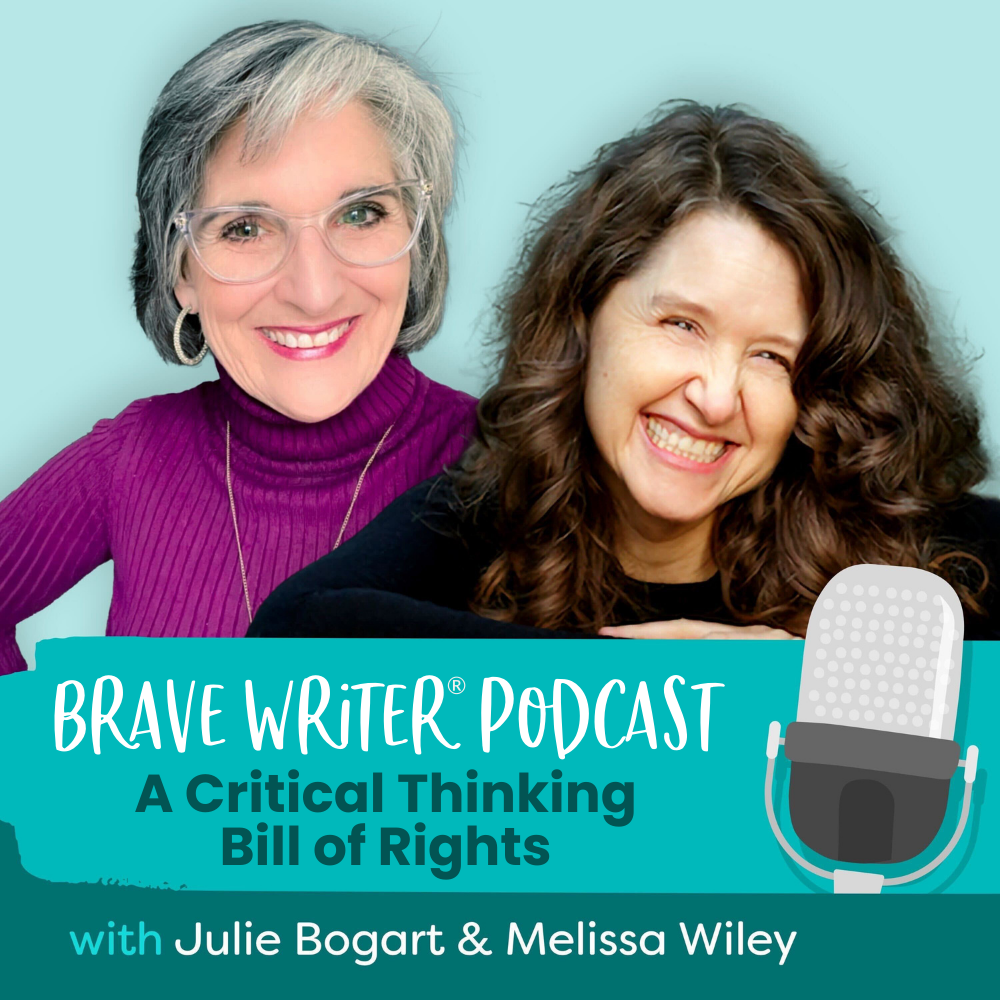
What do you—and your kids—have the right to think, question, and say?
This week on the Brave Writer podcast, we unpack a “Critical Thinking Bill of Rights” and apply it to homeschooling life. We explore the pull of group identity, the courage to disagree with leadership, the power of private thoughts, and the freedom to change your mind.
We talk about:
- fairness in co-ops,
- resisting performative values,
- and raising kids who can think for themselves without fear.
If you’ve ever felt pressure to conform or questioned whether you’re “doing homeschool right,” this conversation will steady you.
Join us—and then talk through these rights with your kids.
Show Notes
When we chose homeschooling, we stepped away from the status quo. That decision required thoughtfulness and courage. Yet once outside conventional schooling, many of us feel pressure to find a new authority, a new label, or a new group to anchor us. What if instead we anchored ourselves in a set of rights that protect independent thinking? Here is a Critical Thinking Bill of Rights for homeschool families—ten reminders that safeguard intellectual freedom in our homes.
1. You Have the Right to Your Own Thoughts and Viewpoint
You own your mind. Exposure to a book, speaker, curriculum, or philosophy does not require allegiance to it. You can consider ideas without adopting them wholesale. The same is true for your children. When they disagree with you, they are not necessarily being defiant—they are practicing the skill of thinking independently. If we want adults who can reason, evaluate, and discern, we must allow children to try out their own viewpoints safely at home.
2. You Have the Right to Disagree with Leadership
Authority does not erase your discernment. Whether it’s a co-op director, a curriculum author, or a long-standing homeschool philosophy, you are allowed to question and disagree. Respectful dissent is not disloyalty. In fact, learning how to disagree thoughtfully is one of the most important skills we can model for our kids. Homeschooling invites us to participate in education, not passively submit to it.
3. You Have the Right to Private Thoughts
Not every idea needs immediate public expression. Some thoughts require quiet reflection before they are ready to be shared. There is a difference between secrecy born of shame and privacy born of process. Journaling, thinking time, and internal wrestling are healthy parts of intellectual growth. Our children deserve space to think without fear of premature scrutiny.
4. You Have the Right to Not Know
Homeschooling is filled with uncertainty. We try approaches, adjust rhythms, and learn as we go. It is honest—and healthy—to say, “I don’t know yet.” We are not required to predict outcomes before taking a step. Modeling comfort with uncertainty teaches our children that learning is iterative and that wisdom develops over time.
5. You Have the Right to Change Your Mind
Growth often looks like revision. Interests evolve, needs shift, and philosophies mature. A family that once embraced one educational style may pivot to another. A child who loves one subject deeply may lose interest and move on. Changing your mind is not inconsistency—it is responsiveness to new information and lived experience.
6. You Have the Right to Not Be Defined by the Group That Claims You
Labels can help us find community, but they should never flatten our individuality. You are more than a category. Even within a shared philosophy, families express it differently. No group has the authority to dictate the totality of your identity. You get to define your homeschool in ways that reflect your real life.
7. You Have the Right to Speak Up, Even If Your Voice Falters
Not everyone thinks quickly or speaks confidently in the moment. Some need time. Some need space. Still, every person deserves the opportunity to be heard. In our homes, we can cultivate habits of listening patiently and responding respectfully. Encouraging hesitant voices builds confidence and strengthens the culture of dialogue within our families.
8. You Have the Right to Expect Evidence, Proof, and Consistency
You do not have to accept ideas simply because they are popular or passionately delivered. Asking “Why?” and requesting clarification is a sign of engagement, not rebellion. Healthy critical thinking includes evaluating evidence and noticing whether arguments are internally consistent. We can teach our children to weigh ideas thoughtfully rather than accepting them on authority alone.
9. You Have the Right to Hold People Accountable to Their Stated Values
When leaders, communities, or even parents express certain values, it is reasonable to expect those values to be lived out consistently. Accountability does not require hostility. It simply invites alignment between words and actions. Teaching our children to notice this alignment helps them develop integrity in their own lives as well.
10. You Have the Right to Expect Fairness and Courtesy
Disagreement does not justify disrespect. If a conversation shifts into character attacks or dismissiveness, it is no longer productive. Within homeschool communities—and within our own families—we can insist on fairness and kindness as the baseline for dialogue. Critical thinking flourishes best in environments where people feel safe to speak honestly without fear of humiliation.
Homeschooling is not merely an academic choice. It is a daily practice of thinking, revising, questioning, and growing together. When we honor these ten rights in our homes, we raise not performers who conform, but thinkers who engage the world with clarity and courage.
Resources
- Read Julie’s Substack post on her Critical Thinking Bill of Rights
- Find our favorite readalouds and nonfiction in the Brave Writer Book Shop
- Brave Writer class registration is open!
- Visit Julie’s Substack to find her special podcast for kids (and a lot more!)
- Purchase Julie’s new book, Help! My Kid Hates Writing
- Find community at the Brave Learner Home
- Learn more about the Brave Writer Literature & Mechanics programs
- Start a free trial of CTCmath.com to try the math program that’s sure to grab and keep your child’s attention
- Subscribe to Julie’s Substack newsletters, Brave Learning with Julie Bogart and Julie Off Topic, and Melissa’s Catalog of Enthusiasms
- Sign up for our Text Message Pod Ring to get podcast updates and more!
- Send us podcast topic ideas by texting us: +1 (833) 947-3684
- Interested in advertising with us? Reach out to media@bravewriter.com
Connect with Julie
- Instagram: @juliebogartwriter
- Threads: @juliebogartwriter
- Bluesky: @bravewriter.com
- Facebook: facebook.com/bravewriter
Connect with Melissa
- Website: melissawiley.com
- Substack: melissawiley.substack.com
- Instagram: @melissawileybooks
- Bluesky: @melissawiley.bsky.social
Produced by NOVA