[Podcast #327] Becoming a Critical Thinker
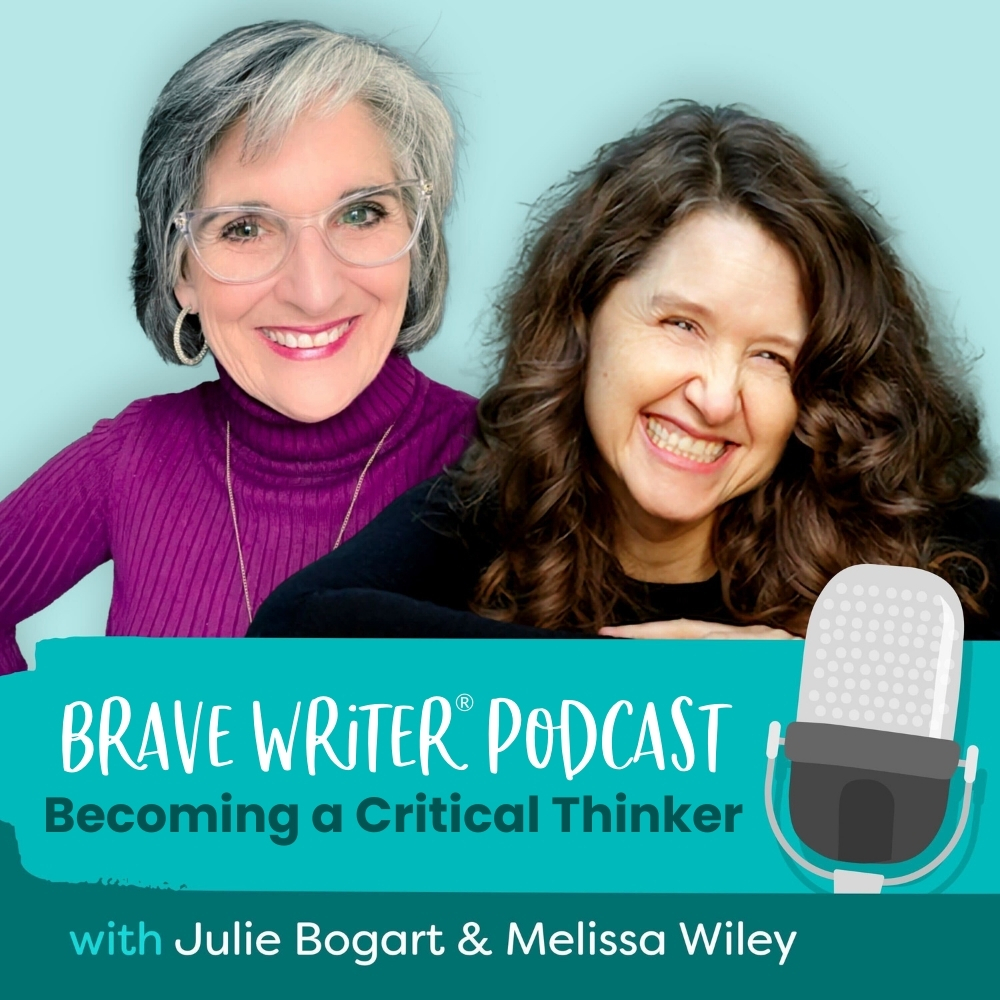
What does it really mean to think critically in a world that never stops shouting at us?
In this Brave Writer podcast episode, we slow things down and explore how to stay grounded when information, emotion, and opinion collide.
We talk about:
- noticing our own reactions,
- asking better questions,
- and learning how to separate facts from the stories wrapped around them.
Along the way, we share practical tools you can use with your kids—and yourself—to build clarity, curiosity, and courage. If you’ve ever felt overwhelmed by the noise or unsure how to model thoughtful engagement, this conversation offers a steady place to begin. Join us, and keep thinking well.
Show Notes
We live in an age of information overload. News arrives faster than we can process it, opinions stack on top of opinions, and emotional reactions often outrun thoughtful reflection. It’s no wonder so many parents feel unsure about how to help their kids make sense of it all. Critical thinking, though often treated as an academic skill, begins much closer to home—in our own habits of mind.
One of the most important shifts we can make is recognizing that critical thinking doesn’t start with evaluating someone else’s argument. It starts with noticing ourselves. Before reading an article, opening an email, or responding to a post, we can ask a deceptively simple question: What do I hope will be true? That single moment of awareness reveals how much emotion, identity, and desire shape the way we receive information.
Right-Sizing Our Reactions
Not every piece of information deserves the same level of alarm or passion. Learning to match our emotional response to the actual stakes of a situation is a core critical thinking skill. Overreacting to minor issues leaves us exhausted. Underreacting to serious ones can be dangerous. When kids see us calmly assess what matters—and why—they learn that thinking isn’t about panic or dismissal. It’s about proportion.
Turning the Lens Inward
An “academic selfie” invites us to examine assumptions we’ve stopped questioning. Why do we label some schools as “good” and others as “bad”? Why do we accept uneven teaching quality in institutions that promise excellence? When we turn the lens inward, we model humility and curiosity. We show kids that growth begins by examining what we take for granted.
Facts, Stories, and the Space Between
Facts never arrive alone. They’re always embedded in stories shaped by word choice, order, and tone. Separating verifiable details from narrative framing helps remove some of the emotional charge. Dates, names, actions, locations, and data give us something solid to hold onto when everything else feels slippery.
At home, this can look like reading two articles on the same topic—without knowing the source—and noticing what feels persuasive, irritating, or comforting. Those reactions are data too.
Curiosity Over Combat
When disagreements arise, curiosity opens doors that confrontation slams shut. Asking someone how their view makes the world better invites explanation rather than defensiveness. It also gives us insight into values, fears, and priorities we might otherwise miss. That same posture helps our kids feel safe bringing us questions that don’t yet have neat answers.
Critical thinking isn’t about winning arguments or proving ourselves right. It’s about developing the courage to look honestly at information, beliefs, and emotions—our own included. When we create homes where curiosity is welcomed and thinking is allowed to evolve, we give our children something far more lasting than answers. We give them the tools to think well.
Resources
- Find Raising Critical Thinkers and Becoming a Critical Thinker on Julie’s website at juliebogartwriter.com
- Brave Writer class registration is open!
- Visit Julie’s Substack to find her special podcast for kids (and a lot more!)
- Purchase Julie’s new book, Help! My Kid Hates Writing
- Find community at the Brave Learner Home
- Learn more about the Brave Writer Literature & Mechanics programs
- Start a free trial of CTCmath.com to try the math program that’s sure to grab and keep your child’s attention
- Subscribe to Julie’s Substack newsletters, Brave Learning with Julie Bogart and Julie Off Topic, and Melissa’s Catalog of Enthusiasms
- Sign up for our Text Message Pod Ring to get podcast updates and more!
- Send us podcast topic ideas by texting us: +1 (833) 947-3684
- Interested in advertising with us? Reach out to media@bravewriter.com
Connect with Julie
- Instagram: @juliebogartwriter
- Threads: @juliebogartwriter
- Bluesky: @bravewriter.com
- Facebook: facebook.com/bravewriter
Connect with Melissa
- Website: melissawiley.com
- Substack: melissawiley.substack.com
- Instagram: @melissawileybooks
- Bluesky: @melissawiley.bsky.social
Produced by NOVA