Young Writers Archives - Page 7 of 34 - A Brave Writer's Life in Brief A Brave Writer's Life in Brief
  • Start Here
    • For Families
      Multiple Ages
    • Ages 5-7
      Beginning Writers
    • Ages 8-10
      Emerging Writers
    • Ages 11-12
      Middle School Writers
    • Ages 13-14
      High School Writers
    • Ages 15-18
      College Prep Writers
  • Shop
    • Product Collections
    • Bundles
    • Writing Instruction Manuals
    • Literature & Grammar/Punctuation
    • Composition Formats
    • Literature Singles
    • Homeschool Help
    • Book Shop
    • Special Offers
  • Online Classes
    • Class Descriptions
    • Class Schedule
    • Classroom
    • How Our Classes Work
    • Our Writing Coaches
    • Classes FAQ
  • Community
    • Brave Learner Home
    • What’s Happening
    • Blog
    • Podcast
    • Calendar
  • Cart
  • My Account
    • My Online Classes
    • My Account
  • My Account
    • My Online Classes
    • My Account
  • Start Here

    If you’re new to Brave Writer, or are looking for the best products for your child or family, choose from below:

    • For Families
      Multiple Ages
    • Ages 5-7
      Beginning Writers
    • Ages 8-10
      Emerging Writers
    • Ages 11-12
      Middle School Writers
    • Ages 13-14
      High School Writers
    • Ages 15-18
      College Prep Writers
  • Shop

    If you’re already familiar with Brave Writer products, go directly to what you’re looking for:

    • Product Collections Browse the full catalog in our shop
    • Bundles Everything you need to get started
    • Writing Instruction Manuals Foundational Writing Programs
    • Literature & Grammar/Punctuation Grammar, Punctuation, Spelling & Literary Devices
    • Composition Formats Writing Assignments for Every Age
    • Literature Singles Individual Literature Handbooks
    • Homeschool Help Homeschooling Tools and Resources
    • Book Shop Books associated with Brave Writer Programs
    • Special Offers
  • Online Classes
    • Class Descriptions
    • Class Schedule
    • Classroom
    • How Our Classes Work
    • Our Writing Coaches
    • Classes FAQ
  • Community
    • Brave Learner Home
    • What’s Happening
    • Blog
    • Podcast
    • Calendar
  • Search
  • Cart

Search Bravewriter.com

  • Home
  • Blog

A Brave Writer's Life in Brief

Thoughts from my home to yours

Archive for the ‘Young Writers’ Category

« Older Entries
Newer Entries »

Tips for Young Writers

Tips for young writers

Tips for your young writers (ages 5-8):

1. The best curriculum for this age is still face paints and dress up clothes. Play, exploration, acting out—these teach. Trust the process.

2. Riddles, jokes, rhymes, poems, puns, secrets, mysteries, the alphabet (write it big, write it small, write it backwards, write it with chalk on the driveway, write it one letter per page, fit all the letters on a post-it note, write every other letter – not easy!), names (family, pets, streets, cities, imaginary friends, real friends, favorite characters). Play, explore, write, say, pretend with all of these, often, as much as you can.

3. For original writing: they talk, you write it down. End of discussion. Unless they are choosing to write their own thoughts on their own, you have no obligation to get them to write their own thoughts in their own hand by themselves. If they are writing their own thoughts, hug them—be a fan. Not a word of criticism about spelling, handwriting, story completion, or logic. Just kudos for the surprise of their self-starting joy!

4. For transcription: a handwriting book, simple copywork (one word a day can be more than enough for some kids), French dictation (explained in BW products), copying their own stories (only have them copy a paragraph, a sentence at a time, or more if THEY choose, but don’t require more in one sitting).

5. Read TO your kids OUT LOUD, everything you see—billboards, refrigerator magnets, ads in magazines you are paging through, funny comments on Facebook as you scroll through your feed, the text your husband just sent, the preface to a book, the instructions for the XBox, newspaper briefs, the side of the spice jar, the back of the muffin mix, the clever tag line on the shoe box… And yes, read quality literature aloud too. But read everything aloud… freely, often, commenting, laughing about it, noticing it.

6. Pair odious tasks with brownies and hugs.

7. Get outside, have big experiences, explore the world. For heaven’s sake, don’t worry yet. You’ll get to worry so much in the teen years and pine for these early years. So I’m here to tell you—play, explore, enjoy. Pick a fruit no one has ever eaten and eat it. Go to the zoo 3 times a week or the beach or the woods, if you dare. Make recipes for sludge and slime and baking soda volcanoes. No worrying.

That’s it. Really. Math isn’t my thing, but you can figure that out I’m sure. As my wise homeschool mom friend said to me: “Any math book teaches 1+1. Heck, we can do it ourselves.”

Also, our Jot It Down product is perfect for these ages!

Jot It Down

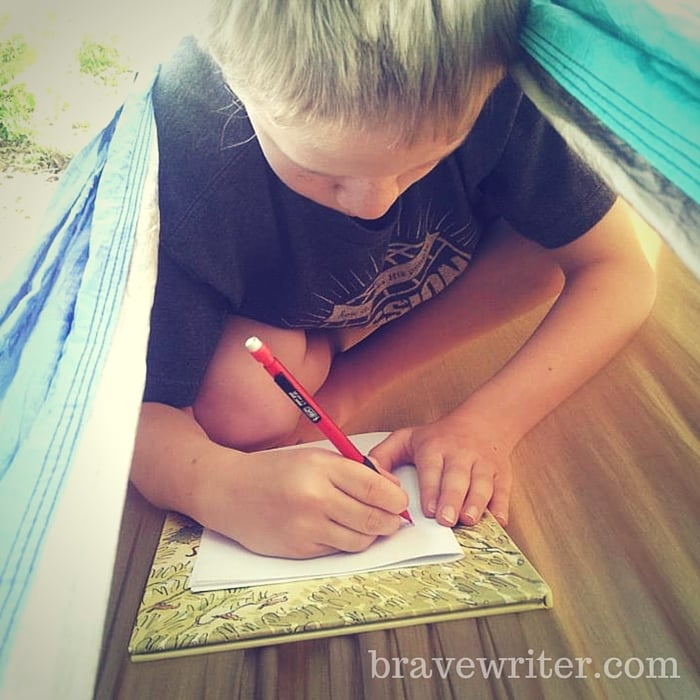
Header image by Brave Writer mom Tiffany
Posted in Young Writers | Comments Off on Tips for Young Writers

Retelling: Details or Summary or Both?

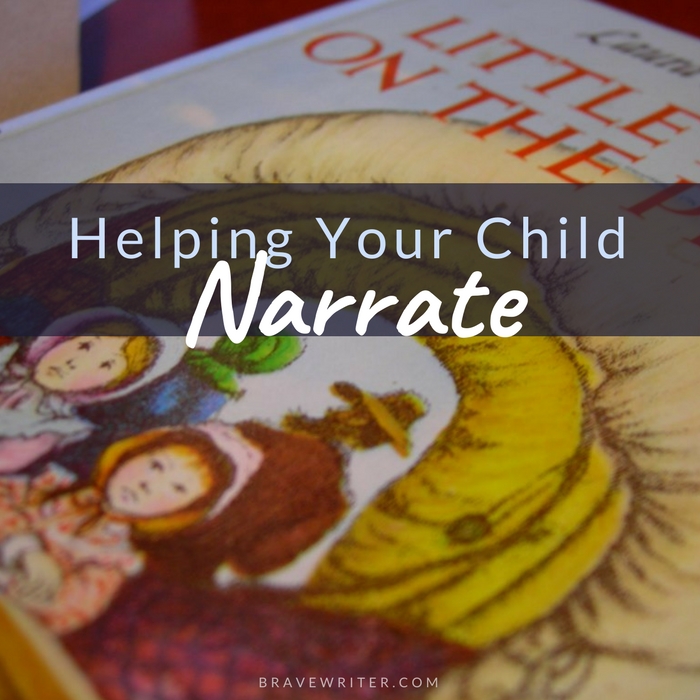
Helping Your Child Narrate

Great phone call today. Here’s the gist:

Mom: What do I do when my son [age 11] retells the details of a book or movie or story, but he can’t tell me the overarching narrative that goes with it? Like he can’t say the main plot points. He rambles and gets caught up in details that are non-essential to the plot, but he tells them with so much accuracy and depth, I hate to stop him.

My response:

Adults summarize. They can pick out the main points and sequence them. They’ve read 1000s of stories, watched as many films, and are well aware of the narrative arc (plot diagram) by virtue of time on the planet and years logged reading/absorbing “story.”

Kids don’t have this background, and can’t summarize like you. They’re younger. Story is fresh for them. They are beguiled by subplots and character quirks and twists. They chase the shiny object called “weapons,” “cute puppies,” “sassy friends,” “weird creatures,” “magic spells” or “epic battles” and report all that is filling their imaginations to the brink of enthusiasm. When you ask them to tell you about the story, the most exciting, fascinating points overflow. They can’t “sort” the images and emotions. They aren’t likely to sequence events into the narrative arc. They retell the memorable moments, with detail, reliving them in front of you.

Of course, most adults have completely lost the ability to trap details to that extent. Our brains are too busy for detail. We save the important markers and ditch the quirky dialog or style of weaponry. Children can retell with amazing accuracy. We have too many digits, words, experiences, memories, obligations in the way of uncluttered retelling. We hang onto the big picture and file it under “mental notecard” – as in, if asked, this is what I share.

Retelling: details or summary or both?

Being able to summarize is a fairly sophisticated skill. It is possible to cultivate, but please don’t think it a superior skill to retelling in detail. For now, here’s how I want you to proceed:

Start by listening, really closely. Ask real questions that help you understand who, what, where, and when as the child relates the particular scene. You can jot down the responses on separate sheets of paper per scene or image or dialog. Keep these on a table in front of you. Ask for key details (names, places, why such-and-such happened).

Print a plot diagram (a simple one).

Then, with these notes in front of you both, ask some of these questions to help sort the information just shared:

1. Pick up one of the stories: Did this event happen at the beginning, or in the middle, or near the end of the story/film/book? Move the note you took to the right place on the table along the narrative arc. Do that for each of the scenes you’ve jotted down.

2. Ask the child what moment decided the outcome (the climax)? It may be difficult to identify the single one (there are lots of sub-plots in most stories). But the BIG one happens near the end. So direct your child’s attention to the end of the plot line. You can even discuss ones that were important along the way, but weren’t the final key determining factor. That’s a good conversation to have!

3. Talk about the characters. Which character is the most important to the story (without whom, there would be no story)? It’s usually obvious, but not always! The main character is called “the protagonist” and that is the one who is a part of the climax. We figure out who is important by how much we care about what happens to that character. A guide to identifying that character, then, is “Whose story do we care the most about?” Of course, your child may love a character in the subplot, but then you can expand backwards and say, “Who do you think the author wants us to care most about?” That will help differentiate.

4. Now talk about the antagonist (the character that wants to thwart the goal of the main character). Who stands to gain by interrupting the progress of the protagonist?

5. Lastly, ask about the events your child narrated to you. Are these related to the protagonist’s plight? Or are they about side-kick characters? If they are “side-kick characters,” we call these scenes part of the “sub-plot.” A sub-plot keeps the story interesting, adds detail to the main plot, and supplies a distraction or complication when the author needs one. Figure out whether the memorable scenes are plot or subplot.

Retelling: details or summary or both?

Once you’ve collected this data, see if you can put it in a meaningful whole. You might narrate back to your child all the information you’ve collected and demonstrate what it means to put it in sequence. Once you’ve done that, you can ask your child to correct you, add to it, or try his/her own hand at it! Overtime, you can ask the child to take over and create the narration from this material from scratch.

What I hope you’ll take from this post:

Work with what your kids give you! Help them sort it out. Model what it looks like when it matches what you are hoping to hear. Then give them the chance to do it, with your help.

Do not abandon your child to your expectations and then wring your hands when they fail. Teach! That’s your job and your privilege.


Brave Writer Arrow Book ClubOur  Arrow Book Club provides an online discussion space for students (ages 10-12) to discuss literature using literary analysis vocabulary without the pressure of writing “essays.” Homeschool students especially need the chance to talk about what they read—-yet the busy mother-of-many doesn’t always have time to take the discussion to a written form.


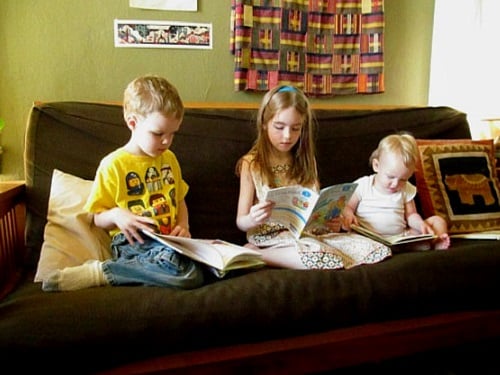
Images: Children reading by Brave Writer mom, Kort / Girl reading on bed by Personal Creations (cc)

Posted in Email, Literary elements, Reading, Young Writers | 4 Comments »

Sick Day

DSCN5272 It’s that time of year where we all start sniffling and coughing. Shel Silverstein to the rescue! Use this poem for copywork or poetry teatime or just to read aloud for the sheer joy of it.

Sick, by Shel Silverstein

“I cannot go to school today,”
Said little Peggy Ann McKay.
“I have the measles and the mumps,
A gash, a rash and purple bumps.
My mouth is wet, my throat is dry,
I’m going blind in my right eye.
My tonsils are as big as rocks,
I’ve counted sixteen chicken pox
And there’s one more–that’s seventeen,
And don’t you think my face looks green?
My leg is cut–my eyes are blue–
It might be instamatic flu.
I cough and sneeze and gasp and choke,
I’m sure that my left leg is broke–
My hip hurts when I move my chin,
My belly button’s caving in,
My back is wrenched, my ankle’s sprained,
My ‘pendix pains each time it rains.
My nose is cold, my toes are numb.
I have a sliver in my thumb.
My neck is stiff, my voice is weak,
I hardly whisper when I speak.
My tongue is filling up my mouth,
I think my hair is falling out.
My elbow’s bent, my spine ain’t straight,
My temperature is one-o-eight.
My brain is shrunk, I cannot hear,
There is a hole inside my ear.
I have a hangnail, and my heart is–what?
What’s that? What’s that you say?
You say today is. . .Saturday?
G’bye, I’m going out to play!”

Posted in Brave Writer Lifestyle, Copywork Quotations, Dictation and copywork, Poetry, Young Writers | 1 Comment »

« Older Entries
Newer Entries »
  • Search the Blog

  • Julie Bogart
  • Welcome, I’m Julie Bogart.

    I’m a homeschooling alum -17 years, five kids. Now I run Brave Writer, the online writing and language arts program for families. More >>

    IMPORTANT: Please read our Privacy Policy.

  • New to Brave Writer? START HERE

  • FREE Resources

    • 7-Day Writing Blitz
    • Brave Writer Lifestyle Program
    • Brave Writer Sampler: Free Sample Products
    • Freewriting Prompts
    • Podcasts
  • Popular Posts

    • You have time
    • How writing is like sewing
    • Best curriculum for a 6 year old
    • Today's little unspoken homeschool secret
    • Do you like to homeschool?
    • Don't trust the schedule
    • You want to do a good job parenting?
    • If you've got a passel of kids
    • You are not a teacher
    • Natural Stages of Growth in Writing podcasts
  • Blog Topics

    • Brave Learner Home
    • Brave Writer Lifestyle
    • Classes
    • Contests/Giveaways
    • Friday Freewrite
    • High School
    • Homeschool Advice
    • Julie's Life
    • Language Arts
    • Movie Wednesday
    • Natural Stages of Growth
    • One Thing Principle
    • Our Team
    • Parenting
    • Philosophy of Education
    • Podcasts
    • Poetry Teatime
    • Products
    • Reviews
    • Speaking Schedule
    • Students
    • Writing about Writing
    • Young Writers
  • Archives

  • Brave Writer is a participant in the Amazon Services LLC Associates Program, an affiliate advertising program designed to provide a means for sites to earn advertising fees (at no extra cost to you) by advertising and linking to amazon.com

    Content © Brave Writer unless otherwise stated.

What is Brave Writer?

  • Welcome to Brave Writer
  • Why Brave Writer Works
  • About Julie
  • Brave Writer Values
  • Frequently Asked Questions
  • Speaking Schedule

Brave Writer Program

  • Getting Started!
  • Stages of Growth in Writing
  • The Brave Writer Program
  • For Families and Students
  • Online Classes
  • Brave Writer Lifestyle

…and More!

  • Blog
  • Classroom
  • Store
  • Books in Brave Writer Programs
  • Contact Us
  • Customer Service
  • Brave Writer Staff
© 2026 Brave Writer
Privacy Policy
Children's Privacy Policy
Help Center