Young Writers Archives - Page 22 of 34 - A Brave Writer's Life in Brief A Brave Writer's Life in Brief
  • Start Here
    • For Families
      Multiple Ages
    • Ages 5-7
      Beginning Writers
    • Ages 8-10
      Emerging Writers
    • Ages 11-12
      Middle School Writers
    • Ages 13-14
      High School Writers
    • Ages 15-18
      College Prep Writers
  • Shop
    • Product Collections
    • Bundles
    • Writing Instruction Manuals
    • Literature & Grammar/Punctuation
    • Composition Formats
    • Literature Singles
    • Homeschool Help
    • Book Shop
    • Special Offers
  • Online Classes
    • Class Descriptions
    • Class Schedule
    • Classroom
    • How Our Classes Work
    • Our Writing Coaches
    • Classes FAQ
  • Community
    • Brave Learner Home
    • What’s Happening
    • Blog
    • Podcast
    • Calendar
  • Cart
  • My Account
    • My Online Classes
    • My Account
  • My Account
    • My Online Classes
    • My Account
  • Start Here

    If you’re new to Brave Writer, or are looking for the best products for your child or family, choose from below:

    • For Families
      Multiple Ages
    • Ages 5-7
      Beginning Writers
    • Ages 8-10
      Emerging Writers
    • Ages 11-12
      Middle School Writers
    • Ages 13-14
      High School Writers
    • Ages 15-18
      College Prep Writers
  • Shop

    If you’re already familiar with Brave Writer products, go directly to what you’re looking for:

    • Product Collections Browse the full catalog in our shop
    • Bundles Everything you need to get started
    • Writing Instruction Manuals Foundational Writing Programs
    • Literature & Grammar/Punctuation Grammar, Punctuation, Spelling & Literary Devices
    • Composition Formats Writing Assignments for Every Age
    • Literature Singles Individual Literature Handbooks
    • Homeschool Help Homeschooling Tools and Resources
    • Book Shop Books associated with Brave Writer Programs
    • Special Offers
  • Online Classes
    • Class Descriptions
    • Class Schedule
    • Classroom
    • How Our Classes Work
    • Our Writing Coaches
    • Classes FAQ
  • Community
    • Brave Learner Home
    • What’s Happening
    • Blog
    • Podcast
    • Calendar
  • Search
  • Cart

Search Bravewriter.com

  • Home
  • Blog

A Brave Writer's Life in Brief

Thoughts from my home to yours

Archive for the ‘Young Writers’ Category

« Older Entries
Newer Entries »

Freewheeling freewriting

Email:

Dear Julie,

I am a homeschooling mom of three girls ages 13, 10 and 7.  We just tried free writing this last week, and I just wanted to say thank you for writing about it.  The kids enjoyed it more than almost anything else we have done for schoolwork in awhile.  That sounds pretty bad, but I have been stressing out about what they are and are not learning lately, especially my 13yodd.  I look at her in all her 7th grade glory and think, “Boy, I am really going to mess her up from here on out if I’m not careful to teach her properly.”  That fear just stifles my instincts as to what is best for her and her sisters. I’m planning a lot more freewrites!

I know you probably get a ton of email, but I just wanted to offer my appreciation and to let you know how much my straight-laced, sweet, careful girl enjoyed knowing that spelling and punctuation didn’t count in this writing assignment.  Here is her first freewrite:

The water in the cup near me looks blue Is it? I love Mommy that M is awful but I dont care haha I didn’t put any apostrophe in dont look I did it again and i like it and my I is not capitalized. I griped to thumper about being thirteen this morning and cried but then at 2:15 I went out and apologized she growled What was this guy’s name again? I love Mommy’s rolls or biskits or whaterer they are called haha look bad spelling What happens if we run out of paper before 10 minutes is up? I don’t know and I won’t care until I get there I can’t wait to go to California and tell Ggmom and GGDad that we’re 100 % tx and 100% ca! I wish we were there already I like freewriting it’s so ridiculous I was going to write something else but I forgot it 🙂 I don’t know if smileys go on paper I wish I could get into my Squirrel Band drawings whoa I’m thirsty but I still have 5 min or actually a bit less hey we’re going to a church meeting tonight I wish I could bring Thumpee don’t ask why did you know the early Celts wore hare instead of underwear? I’m spelling words I’ve known how to spell forever but I’m spelling them wrong and don’t care the Celts didn’t wear bunnies sorry they wore HAIR Mariel and Cornflower are mad at each other and I’m getting writers cramp I never realized I thought about such a wide variety of subjects!

Sincerely,
Katie Barr

—

I love this freewrite! Talk about free, talk about exploration of her mind. Even her deliberate misspellings and loss of punctuation reveal that she knows the correct versions of both. Here she is playing with language, perhaps the way ee cummings or Lewis Carrol did when they were young.
What a marvelous discovery right at the end: “I never realized I thought about such a wide variety of subjects.” Indeed!

Thanks for sharing your daughter’s delightful writing and mind with the rest of us, Katie.
Posted in Email, Young Writers | 2 Comments »

Brave Writer, afterschooling and public schooled kids (Part Two)

Brave Writer and Public School Part 2

Previously, we discussed the differences between homeschool and public school.

So how can Brave Writer help your kids if they’re in school or if they are used to “school at home” (where homeschool duplicates the learning style of school with text books, workbooks and schoolish expectations)?

The important part of writing that gets overlooked (sometimes) by a school setting is the writer’s natural writing voice. While punctuation, grammar and spelling are important to the finished product of writing, these are not central to the art of writing (that process of dredging up words from the deep and getting them onto paper).

Writing has to make space for risk. Without risk, writers don’t grow. They may learn how to conform to expectations adequately, but they will not flourish as writers. What that means is that if your child is in a program at school that is squelching his or her natural writing voice, where you see writing developing into a resented subject, it’s time to intervene. Here are some practical tips for how Brave Writer can help you help your kids.

  1. Introduce weekly freewriting.
    Freewriting is the process by which kids get to express their written ideas and thoughts without the pressure to perform to someone else’s expectations. For kids in school, the initial feeling about freewriting might be that they are sick of writing and would like a break (not more of it at home). To counteract that feeling, try freewriting in a new setting. Get out of the house, sip a hot drink and freewrite together. You can turn a weekly freewriting time into shared quality time together. Explain that this writing is meant to help the child take risks, explore his or her sense of humor, to write all the silly things he or she wants to get out but can’t in school.
  2. Make use of the Keen Observation exercise.
    You don’t need to do this one every week, but it is very beneficial a couple times a year. The purpose of the Keen Observation Excerise is to help your child see the world more closely giving it language to express what is seen. For afterschooling, this particular exercise offers your kids the chance to slow the process of writing down. Rather than producing full sentences or paragraphs, the child gives full attention to phrases and words that match his or her experience of the item being observed. This exercise then gives you a bench mark for school writing projects. How can your child recall that experience of engaged observation to convey the assignment’s topic?
  3. Read to your kids.
    There’s a tendency to think that if a child can read, that student should read to himself. Schools no longer indulge in reading to children much past age 9. You can do it differently. Rather than everyone finishing an evening together in front of the TV, select a quality work and read it a chapter at a time before bed each night. Fiction is wonderful, but don’t forget about quality non-fiction too. We’ve read books like The Wind Masters (about the flight and habits of raptors) as well as Where in the World? A Geografunny Guide to your Globe as read alouds because they were well-written and entertaining. When you read to a child, you slow the words down so that your son or daughter really hears them. You have the chance to explain processes or plot twists, you enjoy the humor, you live the story together and will naturally find connecting points in your daily life. These book experiences help your child internalize quality writing.
  4. Go easy on school grades for writing.
    Remember that elementary and junior high school grades don’t mean much in the scheme of things. Getting poor marks for spelling or handwriting says nothing about a student’s ability to write. When you read anything your child produces for school, identify what you really loved about the content and ignore any remarks on the paper about the mechanics of writing. Focus all your attention on the language (word choices) and content (what the child attempted to convey). Keep your remarks to the strictly positive. Be specific, “You know so much about hummingbirds. I didn’t know that they ____________. And how funny that you call them “Little honeysuckle suckers” because that is so much what they’re like. The words make music when I read them.” Save and share any writing your kids produce that they like with someone else (spouses make perfect audiences, but so do grandparents, aunts, uncles, close family friends).

The Writer’s Jungle is still an excellent resource for moms whose kids are in school. It helps mothers understand how to facilitate and support a child’s growth as a writer. Certainly there are additional challenges to overcome since school writing is heavy on correction and slight on meaningful praise. Your job is to shore up what the teacher fails to do. Become your child’s ally, not one more critical voice.

If you don’t know how to do that, sign up for Kidswrite Basic. This class can be done in combination with school (we’ve had several public school parents and kids in our courses over the years).

You’ll discover more than how to write, but how to be the person in your child’s life that can overcome the negative influences of poor writing instruction.

Write for Fun!

Posted in Brave Writer Philosophy, BW and public school, General, Writing Exercises, Young Writers | 1 Comment »

How does she do it?


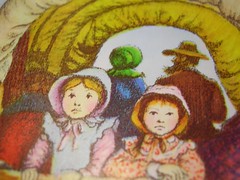
Little House
Originally uploaded by juliecinci

Every now and then, a writer I’ve read countless times tricks me into rereading her work. As I selected passages for the September issue of the Arrow from Little House on the Prairie (a book I’ve read so many times, I can practically narrate it chapter by chapter from memory), I meant to simply thumb through my 1960s hardback volume to my favorite quotations and then jot them down…

Instead, my teaspoon poised itself in front of my mouth as my French onion soup went cold while I read the first four chapters without a pause or a breath… I rushed to the part where we find out whether or not Laura’s dog Jack survives being washed downstream in a rising creek after his long journey from Wisconsin to Kansas, running the whole way on foot under the covered wagon.

I know how it turns out. I know it so well, I can almost quote the poignant description. But somehow, any time I start reading the opening lines of this book, I can’t stop until I get to that most exquisite writing which releases me from the prison of narrative tension.


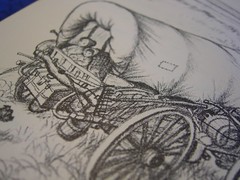
Little House 2
Originally uploaded by juliecinci

Laura Ingalls Wilder is one writer who gets more done with simple language than just about any other children’s writer. She so thoroughly inhabits the mind life of a little girl, you forget that she’s in her sixties at the time of writing.

I first heard the Little House series read to me by my mother. She sat in my bed, back against the headboard, reading the books chapter by chapter in her soothing voice. So special did our readings become that for years afterwards, my mother continued to purchase and give to me Laura paraphernalia and any other books related to her life as they were published. I have the full set of hard back books as well as many other Laura related publications all housed in my bookcase.

Eight years ago, I finally had the joy of visiting South Dakota where Laura spent her long winter. Our kids were with me and I had just finished reading the series aloud to them… for the second time. We marveled at the tiny house whose drawing room Laura considered large and spacious. We admired the trees planted for each of the girls. All those years later, they towered over us. What an astonishing experience to see that all we had read found its roots in a real place, among real people. In an odd way, I felt as though we were visiting family. That is the power of Laura’s wonderful writing.

Laura’s books are a gift to every generation. More than a portrait of a moment in history, of pioneering life, Laura Ingalls Wilder offers us timeless writing. If you haven’t read her books, now’s a great time to start.

Posted in General, Living Literature, Young Writers | 3 Comments »

« Older Entries
Newer Entries »
  • Search the Blog

  • Julie Bogart
  • Welcome, I’m Julie Bogart.

    I’m a homeschooling alum -17 years, five kids. Now I run Brave Writer, the online writing and language arts program for families. More >>

    IMPORTANT: Please read our Privacy Policy.

  • New to Brave Writer? START HERE

  • FREE Resources

    • 7-Day Writing Blitz
    • Brave Writer Lifestyle Program
    • Brave Writer Sampler: Free Sample Products
    • Freewriting Prompts
    • Podcasts
  • Popular Posts

    • You have time
    • How writing is like sewing
    • Best curriculum for a 6 year old
    • Today's little unspoken homeschool secret
    • Do you like to homeschool?
    • Don't trust the schedule
    • You want to do a good job parenting?
    • If you've got a passel of kids
    • You are not a teacher
    • Natural Stages of Growth in Writing podcasts
  • Blog Topics

    • Brave Learner Home
    • Brave Writer Lifestyle
    • Classes
    • Contests/Giveaways
    • Friday Freewrite
    • High School
    • Homeschool Advice
    • Julie's Life
    • Language Arts
    • Movie Wednesday
    • Natural Stages of Growth
    • One Thing Principle
    • Our Team
    • Parenting
    • Philosophy of Education
    • Podcasts
    • Poetry Teatime
    • Products
    • Reviews
    • Speaking Schedule
    • Students
    • Writing about Writing
    • Young Writers
  • Archives

  • Brave Writer is a participant in the Amazon Services LLC Associates Program, an affiliate advertising program designed to provide a means for sites to earn advertising fees (at no extra cost to you) by advertising and linking to amazon.com

    Content © Brave Writer unless otherwise stated.

What is Brave Writer?

  • Welcome to Brave Writer
  • Why Brave Writer Works
  • About Julie
  • Brave Writer Values
  • Frequently Asked Questions
  • Speaking Schedule

Brave Writer Program

  • Getting Started!
  • Stages of Growth in Writing
  • The Brave Writer Program
  • For Families and Students
  • Online Classes
  • Brave Writer Lifestyle

…and More!

  • Blog
  • Classroom
  • Store
  • Books in Brave Writer Programs
  • Contact Us
  • Customer Service
  • Brave Writer Staff
© 2026 Brave Writer
Privacy Policy
Children's Privacy Policy
Help Center