Young Writers Archives - Page 20 of 34 - A Brave Writer's Life in Brief A Brave Writer's Life in Brief
  • Start Here
    • For Families
      Multiple Ages
    • Ages 5-7
      Beginning Writers
    • Ages 8-10
      Emerging Writers
    • Ages 11-12
      Middle School Writers
    • Ages 13-14
      High School Writers
    • Ages 15-18
      College Prep Writers
  • Shop
    • Product Collections
    • Bundles
    • Writing Instruction Manuals
    • Literature & Grammar/Punctuation
    • Composition Formats
    • Literature Singles
    • Homeschool Help
    • Book Shop
    • Special Offers
  • Online Classes
    • Class Descriptions
    • Class Schedule
    • Classroom
    • How Our Classes Work
    • Our Writing Coaches
    • Classes FAQ
  • Community
    • Brave Learner Home
    • What’s Happening
    • Blog
    • Podcast
    • Calendar
  • Cart
  • My Account
    • My Online Classes
    • My Account
  • My Account
    • My Online Classes
    • My Account
  • Start Here

    If you’re new to Brave Writer, or are looking for the best products for your child or family, choose from below:

    • For Families
      Multiple Ages
    • Ages 5-7
      Beginning Writers
    • Ages 8-10
      Emerging Writers
    • Ages 11-12
      Middle School Writers
    • Ages 13-14
      High School Writers
    • Ages 15-18
      College Prep Writers
  • Shop

    If you’re already familiar with Brave Writer products, go directly to what you’re looking for:

    • Product Collections Browse the full catalog in our shop
    • Bundles Everything you need to get started
    • Writing Instruction Manuals Foundational Writing Programs
    • Literature & Grammar/Punctuation Grammar, Punctuation, Spelling & Literary Devices
    • Composition Formats Writing Assignments for Every Age
    • Literature Singles Individual Literature Handbooks
    • Homeschool Help Homeschooling Tools and Resources
    • Book Shop Books associated with Brave Writer Programs
    • Special Offers
  • Online Classes
    • Class Descriptions
    • Class Schedule
    • Classroom
    • How Our Classes Work
    • Our Writing Coaches
    • Classes FAQ
  • Community
    • Brave Learner Home
    • What’s Happening
    • Blog
    • Podcast
    • Calendar
  • Search
  • Cart

Search Bravewriter.com

  • Home
  • Blog

A Brave Writer's Life in Brief

Thoughts from my home to yours

Archive for the ‘Young Writers’ Category

« Older Entries
Newer Entries »

How to break old stuff!

Yesterday, Liam and I sat together in the living room while I worked and he read Living Bird (a magazine put out by the Cornell Lab of Ornithology). He started giggling. Then he chuckled. Next thing you know, his body shook while he laughed out loud. Now it’s nearly impossible to get any work done when someone is enjoying a good joke in a piece of writing that is only feet from where you sit! So I had to know the source of such good humor.

Pete Dunne: How to Destroy Your Binoculars

Nobody could have anticipated this problem. Only a few decades ago birders took pains to keep their binoculars in good working order so they would provide years of service.

No longer. Now, with new-and-improved, super-whiz-bang binoculars appearing every other week, birders who already own quality instruments that don’t have the latest technological innovations—coatings that deflect images of European Starlings and House Sparrows; squishy gel-packed bodies as squeezable as toilet paper—are crying for an excuse to ditch their built-to-last-a-lifetime glass so they have an excuse to buy the latest and greatest.

But they can’t. Their current binoculars work just fine. Replacing them will mean hours of negotiation with their conscience, their spouse, or both.

So here, for the benefit of birders suffering new binocular envy, are several proven ways to destroy the binoculars you are using now. I have personally tried every one and will attest to their success.

With that introduction, Dunne then reels off six detailed methods for deep-sixing your aging binoculars. And they are hilarious! Here are two:

1. The ol’ bioncular left on the roof of your car trick. Although this used to be the binocular abuser’s default setting (the equivalent of the dog eating your homework), unfortunately this is not the fail-safe technique it used to be. There are instruments out there now that can take a standard tumble onto tarmac and survive. In order to achieve maximum damage levels as defined by the new, enhanced, bino-destructo scale, you must place your instrument with barrels parallel to the car roof (i.e. not standing upright) so that you can achieve freeway speeds before the instrument goes airborne. If possible, when backing up to retrieve the wreckage, (for insurance purposes) run the instrument over with tires of your car…

(snip)

5. While scanning for hawks, consume a New-York-deli-sized roast beef sandwich (making sure that half the mayo lands on the glass), then introduce the binoculars to a six-month old Labrador retriever with the counsel, “Now be a good dog, Armageddon, and leave those binoculars alone.” Leave the room. Make sure the instruments are within reach and remove all doggy toys from the vicinity.

And if all else fails:

6. Loan them to me. I guarantee you’ll need new instruments by the time you get them back.

We laughed so much reading about the destructive methods of cleaning the lenses using the equivalent of a brillo pad and packing the binocs in a backpack, on a hot day, with a loosened jar of honey to ooze and lubricate the working parts of the instrument.

It occurred to me that this format would make an ideal writing exercise. How many of us have kids who want the latest X Box or Wii or the best saddle for a horse or the newest bicycle or the most recent iPod (the iTouch!) even while the stuff they have works perfectly and used to entertain them for hours? I see that show of hands. Everyone!

So turn them loose. Let them write about how to destroy that old stuff in order to justify the expense of the new stuff.

Hmm. Am I’m unleashing criminal activity against otherwise still-in-good-condition stuff? For the record: I said write about it. Don’t actually do it. 🙂

Posted in Activities, Brave Writer Philosophy, Writing Exercises, Young Writers | 2 Comments »

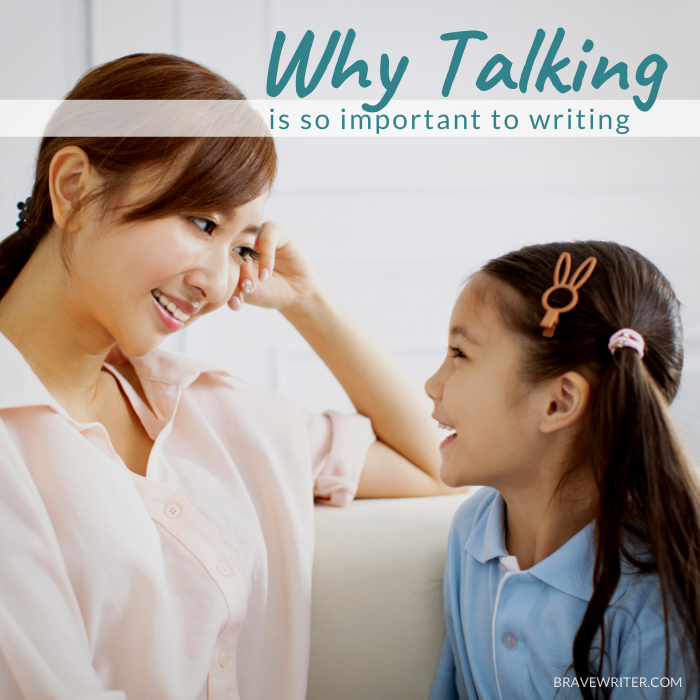
Why Talking is So Important to Writing

Why talking is so important to writing

We want words, lots of them, churned out on reassuring sheets of lined paper, with curlicue cursive ‘r’s and proper punctuation reflecting both the demands of syntax and emotion. When the words fail, we try to coax them out.

What sometimes gets missed in this process is the power of talking. Speaking leads to writing more than any other skill. Getting words formed in the head and then out through the mouth leads to better writing. It doesn’t even matter if they are organized or concise or logical. What matters is the process of dredging them up, giving them room to develop in the mind and then speaking them through the lips by way of the tongue.

Writers make as many words available to themselves as possible. They do this by reading and speaking, speaking and reading… and then writing. There’s a powerful imitation process that gets worked out through talking too. Writers are likely to test new words in conversation before making them a part of their writing vocabularies.

I’m reminded of Jon (my husband) when he’s learning a new language. He has this endearing habit of adopting a new word and using it before he actually knows what it means. He tosses it out in conversation with a native to see the effect it has. He plays with it, attaches it to other words and behaviors. For instance, when we were in Italy three summers ago, he overheard an Italian man say to a woman “Ciao bella.” He could tell from the delivery it had something to do with a greeting or a good-bye but wasn’t entirely sure if it was formal, informal, or even strictly personal and intimate. Yet undeterred, at the next opportunity, he paid for his cappuccino and then winked at the middle-aged barista and declared, “Ciao Bella!” She burst out laughing, patted his arm several times and erupted into more Italian.

Caitrin, picking up on this habit, will often mimic actors and their lines, testing them in conversation for effect. Jacob will ask us if he’s using a word properly when he encounters a new one.

But even these strategies are only part of growing as a writer. Being able to talk to an adult in a supportive, nurturing space increases competence in articulation, in putting words together, that will lead to effective writing later. To support that process, think of these principles when you talk with your kids.

  • Find time to give eye-contact and focused attention. Kids talk better and more if the audience is actually interested. You can give the best level of interest by hearing a story or talking with your child without distractions (not cooking dinner, not cleaning, not shopping). Driving seems to be okay, though, and often leads to some of the best conversations.
  • Involve yourself in the interests of your child. Let your child teach you how to play a game on the Wii, or learn how to shoot baskets, or draw together while your child talks to you about art. Find a way for you to be in the role of “learner” and let your child sort through the vocabulary and sequence of events or practices to help you learn it.
  • Talk about language. When you watch a Shakespeare movie or read a novel or notice a clever billboard, take time to discuss the words themselves, the effects they create, the nuances they reveal. Make words cough up their secret and share these with your kids. Even ask them to see what is funny or clever or insightful about the wording of whatever source.
  • Discuss important things. Trust your kids to tackle big topics with you (according to their ages). Draw them into discussions about ideas like justice, compassion, racism, poverty, space, nature, human and animal rights, education, going green, neighborliness, death, birth, materialism, power, war, punishments and crime, and so on.
  • Don’t shush your kids. It’s easy to want to turn them off when they get rolling on another narration of level 4 of Super Smash Brothers Brawl. I understand. Still, you need to make space for the repetitions, for the meandering so that they can sort it out. If the words stay in their heads, they don’t grow as writers as easily.

So get talking! Snacks help unleash words, too, if you have children who are more reticent to share.


Brave Learner Home

Posted in Brave Writer Philosophy, Young Writers | 4 Comments »

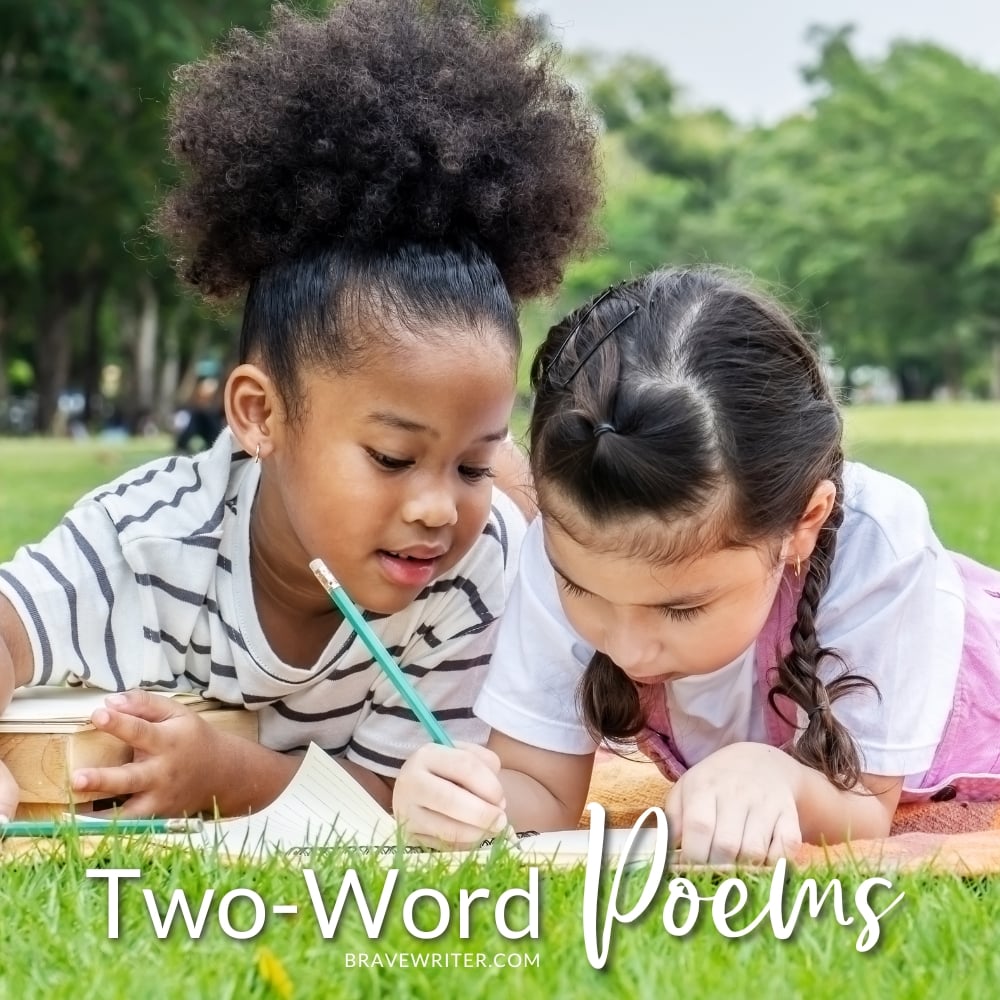
How to Write Two-Word Poems

How to Write Two-Word Poems

If you’re tired of writing lengthy pieces and revising, now’s the time for short and sweet: Two-Word Poems!

Examples:

You.
Boo!

~Anon

bug
ugh

~Students in a classroom

How to Write a Two-Word Poem

Need a little help? Get a book. Pick one word then find another to rhyme it that creates a:

  • word picture,
  • thought,
  • idea,
  • action.

Here are a couple more examples:

sea
wheeeeeee!

fog
bog

Have fun!


Brave Learner Home

Posted in Poetry, Words!, Writing Exercises, Young Writers | 11 Comments »

« Older Entries
Newer Entries »
  • Search the Blog

  • Julie Bogart
  • Welcome, I’m Julie Bogart.

    I’m a homeschooling alum -17 years, five kids. Now I run Brave Writer, the online writing and language arts program for families. More >>

    IMPORTANT: Please read our Privacy Policy.

  • New to Brave Writer? START HERE

  • FREE Resources

    • 7-Day Writing Blitz
    • Brave Writer Lifestyle Program
    • Brave Writer Sampler: Free Sample Products
    • Freewriting Prompts
    • Podcasts
  • Popular Posts

    • You have time
    • How writing is like sewing
    • Best curriculum for a 6 year old
    • Today's little unspoken homeschool secret
    • Do you like to homeschool?
    • Don't trust the schedule
    • You want to do a good job parenting?
    • If you've got a passel of kids
    • You are not a teacher
    • Natural Stages of Growth in Writing podcasts
  • Blog Topics

    • Brave Learner Home
    • Brave Writer Lifestyle
    • Classes
    • Contests/Giveaways
    • Friday Freewrite
    • High School
    • Homeschool Advice
    • Julie's Life
    • Language Arts
    • Movie Wednesday
    • Natural Stages of Growth
    • One Thing Principle
    • Our Team
    • Parenting
    • Philosophy of Education
    • Podcasts
    • Poetry Teatime
    • Products
    • Reviews
    • Speaking Schedule
    • Students
    • Writing about Writing
    • Young Writers
  • Archives

  • Brave Writer is a participant in the Amazon Services LLC Associates Program, an affiliate advertising program designed to provide a means for sites to earn advertising fees (at no extra cost to you) by advertising and linking to amazon.com

    Content © Brave Writer unless otherwise stated.

What is Brave Writer?

  • Welcome to Brave Writer
  • Why Brave Writer Works
  • About Julie
  • Brave Writer Values
  • Frequently Asked Questions
  • Speaking Schedule

Brave Writer Program

  • Getting Started!
  • Stages of Growth in Writing
  • The Brave Writer Program
  • For Families and Students
  • Online Classes
  • Brave Writer Lifestyle

…and More!

  • Blog
  • Classroom
  • Store
  • Books in Brave Writer Programs
  • Contact Us
  • Customer Service
  • Brave Writer Staff
© 2026 Brave Writer
Privacy Policy
Children's Privacy Policy
Help Center