Parenting Archives - Page 9 of 15 - A Brave Writer's Life in Brief A Brave Writer's Life in Brief
  • Start Here
    • For Families
      Multiple Ages
    • Ages 5-7
      Beginning Writers
    • Ages 8-10
      Emerging Writers
    • Ages 11-12
      Middle School Writers
    • Ages 13-14
      High School Writers
    • Ages 15-18
      College Prep Writers
  • Shop
    • Product Collections
    • Bundles
    • Writing Instruction Manuals
    • Literature & Grammar/Punctuation
    • Composition Formats
    • Literature Singles
    • Homeschool Help
    • Book Shop
  • Online Classes
    • Class Descriptions
    • Class Schedule
    • Classroom
    • How Our Classes Work
    • Our Writing Coaches
    • Classes FAQ
  • Community
    • Brave Learner Home
    • What’s Happening
    • Blog
    • Podcast
    • Calendar
  • Cart
  • My Account
    • My Online Classes
    • My Account
  • My Account
    • My Online Classes
    • My Account
  • Start Here

    If you’re new to Brave Writer, or are looking for the best products for your child or family, choose from below:

    • For Families
      Multiple Ages
    • Ages 5-7
      Beginning Writers
    • Ages 8-10
      Emerging Writers
    • Ages 11-12
      Middle School Writers
    • Ages 13-14
      High School Writers
    • Ages 15-18
      College Prep Writers
  • Shop

    If you’re already familiar with Brave Writer products, go directly to what you’re looking for:

    • Product Collections Browse the full catalog in our shop
    • Bundles Everything you need to get started
    • Writing Instruction Manuals Foundational Writing Programs
    • Literature & Grammar/Punctuation Grammar, Punctuation, Spelling & Literary Devices
    • Composition Formats Writing Assignments for Every Age
    • Literature Singles Individual Literature Handbooks
    • Homeschool Help Homeschooling Tools and Resources
    • Book Shop Books associated with Brave Writer Programs
  • Online Classes
    • Class Descriptions
    • Class Schedule
    • Classroom
    • How Our Classes Work
    • Our Writing Coaches
    • Classes FAQ
  • Community
    • Brave Learner Home
    • What’s Happening
    • Blog
    • Podcast
    • Calendar
  • Search
  • Cart

Search Bravewriter.com

  • Home
  • Blog

A Brave Writer's Life in Brief

Thoughts from my home to yours

Archive for the ‘Parenting’ Category

« Older Entries
Newer Entries »

Keeping it real at home

Keeping it real at home

I’m about to make a bold statement.

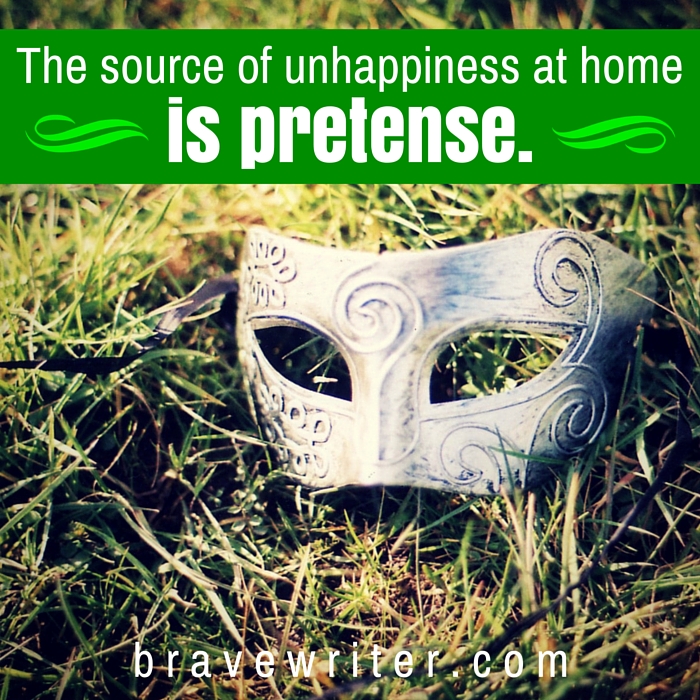
The source of unhappiness at home is pretense.

Pretending in homeschool looks like this:

  • Defending your homeschool to others when you secretly doubt your effectiveness.
  • Showing off the good parts, while hiding the parts that embarrass you.
  • Continuing to use the textbook even though you know it causes pain, just because you paid for it.
  • Endorsing a philosophy of education you don’t actually use (you say you believe in studying the classics, but never read them; you want to believe unschooling is the best way to educate, but you undermine your child’s self-directed learning when it doesn’t match what you thought it would look like).
  • Ignoring a child’s struggles because you don’t want to have to pay for specialists or tutors.
  • Telling yourself that the schools are really really bad so that you can justify your “very bad, no good” year, instead of facing it.
  • Letting your relationship with your kids wither instead of putting in the effort to hear what’s going on for them and making adjustments.
  • Slavish devotion to a method over caring about real learning.
  • Acting as though you are okay with a practice when you really really are not.
  • Ignoring abuse, conflict, disrespect, or volatility in the home, and assuming that those things don’t impact your homeschool.
  • Refusing to consider all options (including the ones you say you don’t believe in) when what you are doing is clearly not working any more.
  • Being more interested in the politics of homeschool (common core, legislation, rights) than in homeschooling.
  • Tweaking your vocabulary to fit the homeschool community’s approved language rather than being true to your own way of thinking.
  • Hiding your child’s behavior or educational failures from others (kids who are dangerous to themselves or others, kids who refuse to cooperate, kids who act out in embarrassing ways—drinking, theft, cyber bullying).
  • Withdrawing from “society” to avoid accountability.

I have often quoted a saying by Iris Murdoch (The Severed Head) without even knowing the source. A Brave Writer mom (Gail) helped me track it down. Let me post it here:

“You can’t cheat the dark gods.”

The truth will out!

Whatever is going on with you is going on with you. No amount of cover-up or smooth-over will fix the problems you face. Moreover, who you are is an essential part of your homeschool. If you hate the classics (no matter how much you persuade yourself that they are essential to education), you will sabotage your homeschool to avoid reading them.

If you do distrust gaming as a way to learn, you will never be happy when your child is on the computer. You will look for ways to manipulate the system to stop your child from doing the very thing you secretly hate and distrust. Which leads to tension and stress in the relationship—inevitably, absolutely, take that to the bank.

If the context of your family is “walking on eggshells” to keep the volatile member from exploding, the energy for learning will be used up by an attempt to control the out of control member—and then you’ll wonder why homeschool is not peaceful or happy or working.

You are not responsible for the reputation of homeschool.

Let me repeat that.

You, sincere-trying-really-hard homeschooler, are not responsible for how other people see you or homeschooling.

You have one responsibility: to create and hold the space for a peaceful environment in which your family can grow and learn.

Create and hold space for a peaceful environment
in which your family can grow and learn.

Click to Tweet

That’s it.

There are scads of ways to get there and as many as there are families. It is right and good to tell your public school mom friend that sometimes you worry that the work you’re doing with your kids is not on par with the local schools. If that’s a real fear, it’s absolutely humanizing and truthful to say it out loud. It doesn’t mean you will change course or decide to put your kids on the big yellow bus. It means you are facing the depth of your own anxiety—just like the public school mom who wonders if the second grade teacher is any good this year.

It is right and good to admit that one child’s ADD or behavior problems is impacting the health of the whole family. Once you admit it, you can begin to seek help for everyone. You are not blaming anyone. You are protecting everyone’s well being.

It is right and good to ditch the program that makes YOU unhappy no matter how many people say it’s the best thing since frosted cake!

Ditch the program that makes YOU unhappy no matter how many say it’s the best thing since frosted cake!

Click to Tweet

It is right and good to admit that it’s easier to fight for the right to homeschool than to homeschool. Start there.

Be real. Everyone wants to support a person who tells the truth. Everyone hates the person who pretends her way into perfection (right?).

You have a universe of choices—keep them all on the table. Be attentive to the muscles in your body. If you feel yourself tighten, you know something is not right. Find out what it is, say it out loud, do something about it.

Keep it real.

Image by Elliot Bennett (cc cropped)

Posted in Homeschool Advice, Parenting | 3 Comments »

Care Less

http://www.dreamstime.com/stock-photos-woman-resting-drink-hammock-image42325933

I don’t mean to be “careless,” but rather, to “care less” (two words). In other words, can you lean back, figuratively put yourself on a porch swing and let your feet dangle as you glide back and forth, not a care in the world—while you homeschool?

Can you relax your jaw, lighten your tone, notice the puffy clouds floating by?

We are so invested in how our kids respond to what we offer them, and how we guide them, that sometimes we jinx the outcome! They stiffen or put up their defenses to avoid having to live up to our expectations.

Think about it: Have you ever felt pressured to like a certain meal someone made for you, or felt you were going to owe such a big show of gratitude for a favor done, you almost wished the person had just not “helped” you?

This may be your kids! It’s tough to know on some intuitive level that my mom’s happiness is contingent on how well I enjoy the lesson, or book, or curricula, or activity, or field trip. The part of us that wants to have our own original experience resists/balks at the pressure to make the “giving person” feel good.

You know what I am talking about—think of your mother or father-in-law or next door neighbor who stands back waiting to be thanked. How do you feel about the service rendered? A little resentful?

Kids have big emotions. They need room to feel and express. It’s never about you—these reactions to books or lessons or strategies for learning. How can it be…really? Who doesn’t want to be loved by a parent, to feel the parent’s approval?

Yet they resist what we offer them when two things happen:

  1. They feel they owe you more than they will get out of it for themselves.
  2. They feel nervous that they can’t live up to your expectations.

So care less. Unschoolers use a term called “strewing” – the strategic placing of unattended items in the way of a learner—allowing a child to explore the item or book or movie or game—unattended, independently, privately.

Other ideas:

  • Do the activity, workbook, lesson, game without the kids, without announcement. Get involved by yourself, in front of them, without a word.
  • Ask your child for help—in any arena. Does this sound like a good program to you? If you could be in charge today, what would we be doing?
  • Openly judge flops with a sense of humor. “That collection of manipulatives must have been created by someone with 12 fingers!”

If the house is filled with tension, try one of these:

  • Disappear. Go into the other room and read a book or page through a catalog, or make yourself a snack.
  • Grab a blanket and curl up on the couch and doze.
  • Head outdoors (put the baby in the backpack). Walk, exercise.

Do not judge a day or week or month gone wrong. Care less. You have tomorrow, tomorrow, and tomorrow. All you have is time. Take the time you need, trust the process, care less about the minutia of today.


Brave Learner Home

Posted in Homeschool Advice, Parenting | 1 Comment »

Compliment one of your kids today

Good Job Smiley Face

Quality affirmation given in a natural, intentional manner yields great results—trust, openness, self-confidence, and a willingness to take more risks. Affirmation need not only focus on a child’s successes, but also a child’s fierce engagement with struggle.

Here are a few models of friendly feedback you can use to help you enhance that parent-child bond:

  • Your voice is loud! I can hear it all the way across a room! That’s fabulous.
  • You were careful coming through that door with the folding chair. I noticed! Thank you.
  • It’s hard to nap. Thanks for trying to get to sleep on your own for ten minutes before getting up to ask me when the nap would be over. Let’s try ten more, shall we?
  • Wow. When you get deeply involved in your game, you can’t even hear me call for lunch. You really know how to focus when you are absorbed.
  • I appreciate your offer to help. That’s really nice of you.
  • You sure know a lot about __________. Must take real concentration to hold onto all those details.
  • That smile of yours? It always makes me a little happier. Thank you.
  • I can tell you are hurting. It’s okay to cry. Strong people cry—it’s a way to let go and recover from sadness.

You get to help define how your kids interpret their experiences. You can do that using positive reinforcements of their natural reactions, and also their attempts to be helpful or to be heard or to caretake themselves.

Affirm one of your kids today—look for opportunities to enhance your child’s self-understanding.

And then make sure you follow up and compliment each of the other ones, each of the remaining days this week and into next week if you need it! Put it on the calendar to remind yourself.

Cross-posted on facebook. Image by Steven Depolo (cc)

Posted in Parenting | Comments Off on Compliment one of your kids today

Invest 30 minutes in the morning

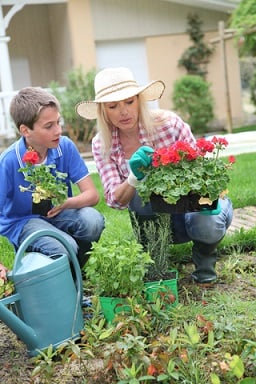
http://www.dreamstime.com/stock-images-gardening-family-image19262314If you spend 30 minutes with your kids right after breakfast, you will be free for the rest of the morning.

Pick an activity that YOU want to do (painting a bedroom, re-potting your indoor house plants, baking cookies, peeling wallpaper in the ugly bathroom, figuring out how to hook up the new game console, cleaning out one closet, washing the camping equipment, reorganizing the cupboards, weeding the garden, watering the flowers, laundry) and involve your kids right with you.

Give assignments to everyone. Even the smallest child can help by dancing to music to entertain you while you read instructions for the IKEA bookcase you want assembled.

It is a slower process to do the needed activity with your kids. It’s even harder to distract them long enough to get it done without their “interference.”

You can circumvent the whole struggle by including them at the get-go. They love grown up activities, they love to be needed, and they can do more than you think (more slowly, with less proficiency). They will find themselves interested and learning while you get through this important task.

At a certain point, their enthusiasm or energy will fade (they are kids and care less about re-potting houseplants than you do). They will leave you to continue while they do something else.

And even if they don’t–if they need to shift activities and you must come with them, at least you will have invested 30 minutes into that project and you will have moved the chains another ten yards down the field.

If you invest 30 minutes right after breakfast, you prevent a build up of resentment, too. You won’t keep hoping for that “slip of time” when they are happy and you can get to work. Instead, you will set the agenda for the day by including everyone up front. You’ll get some of it done (or a lot).

Most importantly, you eliminate resentment (waiting for them to be happy so you can work; waiting for you to finish so they can have a playmate).

So what’s on the agenda today? What are you working on?

Cross-posted on facebook. Image © Goodluz | Dreamstime.com

Posted in Parenting | Comments Off on Invest 30 minutes in the morning

Teach Self-Awareness

Teach Self-Awareness

We spend a lot of time on the 3 R’s and creating a happy, invested learning life with our kids. We show them household skills like wallpaper stripping and toilet-bowl scrubbing.

The chief skill we need to impart for successful relationships in life is self-awareness. Self-awareness, in this little piece, means “the ability to know your thoughts, feelings, and needs; and then to take care of them yourself.”

Blame is what we do when we don’t have self-awareness. We lash out at the nearest person, expecting the unsuspecting, kind bystander to take care of the agitation suddenly erupting inside. For instance, a hungry child may grab your pant leg and whine, “Mommy, I don’t want to go to the store” when really he means, “Mommy, I need a cup of Cheez-its.”

An older child, humiliated in defeat, just beaten by long distance competitors in World of Warcraft, may suddenly yell at a sibling: “Turn down the television! I hate that show!”

The “thing” that evokes the anger or whining is often a cover for what’s really going on. We don’t want to know ourselves because if we do, we must act for our own good. We wrongly assume that it feels better to get someone else to act for us.

One way to foster self-awareness in family members is to have it yourself. Narrate your own self-inquiry and self-care.

“These shoes littering the hallway are driving me crazy! Wait. I just realized that I’m trying to think of how to coordinate Sarah’s dress rehearsal with Sam’s soccer match and these shoes are distracting me from thinking of a solution. I feel like yelling!”

It isn’t always natural to narrate your inner life, but it is helpful when you do. You can also help your children develop self-awareness:

“I see you don’t want to go to the store. Are you hungry? Can I make you a turkey sandwich, first, and then we’ll see if you want to go?”

“Whoa! That’s a huge reaction to the TV. What happened? Did something ‘not good’ happen in your game?”

Eruptions are usually what happen to us when we aren’t attending to the build-up of stress and anxiety inside. We aren’t honest with ourselves—we’re hungry, tired, worried, fearful, insecure. Instead, we blame the nearest intrusion as the reason for our “un-peace.”

Pause, help your child (and yourself!) take responsibility for the panicky explosion. Learn how to self-soothe, how to provide self-care.

I remember when Jacob was a toddler, he’d get worked up into a near-tantrum state. He’d then leave the room and go cry on his bed. When he was finished, he’d come back into the room cheery and ready to play. Pretty high self-awareness for a 2-3 year old!

Help your kids understand how to take themselves out of the room/activity while they figure out what’s going on inside. There’s nothing wrong with being heart-broken about losing a game or annoyed that trips to the store are preventing lunch. Knowing that’s what’s going on is key to family harmony.


The Brave Learner

Posted in Parenting | 1 Comment »

« Older Entries
Newer Entries »
  • Search the Blog

  • Julie Bogart
  • Welcome, I’m Julie Bogart.

    I’m a homeschooling alum -17 years, five kids. Now I run Brave Writer, the online writing and language arts program for families. More >>

    IMPORTANT: Please read our Privacy Policy.

  • New to Brave Writer? START HERE

  • FREE Resources

    • 7-Day Writing Blitz
    • Brave Writer Lifestyle Program
    • Brave Writer Sampler: Free Sample Products
    • Freewriting Prompts
    • Podcasts
  • Popular Posts

    • You have time
    • How writing is like sewing
    • Best curriculum for a 6 year old
    • Today's little unspoken homeschool secret
    • Do you like to homeschool?
    • Don't trust the schedule
    • You want to do a good job parenting?
    • If you've got a passel of kids
    • You are not a teacher
    • Natural Stages of Growth in Writing podcasts
  • Blog Topics

    • Brave Learner Home
    • Brave Writer Lifestyle
    • Classes
    • Contests/Giveaways
    • Friday Freewrite
    • High School
    • Homeschool Advice
    • Julie's Life
    • Language Arts
    • Movie Wednesday
    • Natural Stages of Growth
    • One Thing Principle
    • Our Team
    • Parenting
    • Philosophy of Education
    • Podcasts
    • Poetry Teatime
    • Products
    • Reviews
    • Speaking Schedule
    • Students
    • Writing about Writing
    • Young Writers
  • Archives

  • Brave Writer is a participant in the Amazon Services LLC Associates Program, an affiliate advertising program designed to provide a means for sites to earn advertising fees (at no extra cost to you) by advertising and linking to amazon.com

    Content © Brave Writer unless otherwise stated.

What is Brave Writer?

  • Welcome to Brave Writer
  • Why Brave Writer Works
  • About Julie
  • Brave Writer Values
  • Frequently Asked Questions
  • Speaking Schedule

Brave Writer Program

  • Getting Started!
  • Stages of Growth in Writing
  • The Brave Writer Program
  • For Families and Students
  • Online Classes
  • Brave Writer Lifestyle

…and More!

  • Blog
  • Classroom
  • Store
  • Books in Brave Writer Programs
  • Contact Us
  • Customer Service
  • Brave Writer Staff
© 2026 Brave Writer
Privacy Policy
Children's Privacy Policy
Help Center