
Parenting Archives - Page 21 of 25 - A Brave Writer's Life in Brief A Brave Writer's Life in Brief
  • Start Here
    • For Families
      Multiple Ages
    • Ages 5-7
      Beginning Writers
    • Ages 8-10
      Emerging Writers
    • Ages 11-12
      Middle School Writers
    • Ages 13-14
      High School Writers
    • Ages 15-18
      College Prep Writers
  • Shop
    • Product Collections
    • Bundles
    • Writing Instruction Manuals
    • Literature & Grammar/Punctuation
    • Composition Formats
    • Literature Singles
    • Homeschool Help
    • Book Shop
    • Special Offers
  • Online Classes
    • Class Descriptions
    • Class Schedule
    • Classroom
    • How Our Classes Work
    • Our Writing Coaches
    • Classes FAQ
  • Community
    • Brave Learner Home
    • What’s Happening
    • Blog
    • Podcast
    • Calendar
    • Brave Writer Lifestyle
  • Cart
  • My Account
    • My Online Classes
    • My Account
  • My Account
    • My Online Classes
    • My Account
  • Start Here

    If you’re new to Brave Writer, or are looking for the best products for your child or family, choose from below:

    • For Families
      Multiple Ages
    • Ages 5-7
      Beginning Writers
    • Ages 8-10
      Emerging Writers
    • Ages 11-12
      Middle School Writers
    • Ages 13-14
      High School Writers
    • Ages 15-18
      College Prep Writers
  • Shop

    If you’re already familiar with Brave Writer products, go directly to what you’re looking for:

    • Product Collections Browse the full catalog in our shop
    • Bundles Everything you need to get started
    • Writing Instruction Manuals Foundational Writing Programs
    • Literature & Grammar/Punctuation Grammar, Punctuation, Spelling & Literary Devices
    • Composition Formats Writing Assignments for Every Age
    • Literature Singles Individual Literature Handbooks
    • Homeschool Help Homeschooling Tools and Resources
    • Book Shop Books associated with Brave Writer Programs
    • Special Offers
  • Online Classes
    • Class Descriptions
    • Class Schedule
    • Classroom
    • How Our Classes Work
    • Our Writing Coaches
    • Classes FAQ
  • Community
    • Brave Learner Home
    • What’s Happening
    • Blog
    • Podcast
    • Calendar
    • Brave Writer Lifestyle
  • Search
  • Cart

Search Bravewriter.com

  • Home
  • Blog

A Brave Writer's Life in Brief

Thoughts from my home to yours

Archive for the ‘Parenting’ Category

« Older Entries
Newer Entries »

How to have a “together-style homeschool” if your kids bicker

Bickering_siblings

The following entry is a response to an email asking about how to help siblings get along in the “together-time” of homeschool. My replies are interspersed with her situations.

Below are ideas for some common issues.

Caveat: It’s much much easier to give guidance now that my children are mostly out of the house! My memories are telescoped and not as present-to-me as your current very-alive-to-you frustrations. Just know this: some days just suck. Sometimes everything you try doesn’t work. Sometimes you need breaks from each other, from homeschool, from your house.

Sometimes you try all the “right approaches” and they feel like stiff shoes – not natural to you or how you are as a group. You know your family! The “together-style” homeschool is an option, not a requirement.

With that said, here are some things that worked for us when we faced some of these challenges:

My turn/no your turn: Two options—1) Have more “whatever” available so no turns need to be taken; 2) Don’t use this item/process/book during family homeschool time.

Examples—If your kids are fighting over Legos, you need more Legos. If they are wanting to look at the same book, you may need a second copy or you need another book of comparable interest. This option often requires extra cash and effort. If you don’t have either, go on to suggestion two.

If there is no way to expand the number of items (2-3 sets of binoculars, knitting needles for all, several cameras, a variety of writing implements, many clipboards, several iPads or Tablets, more than one computer), then save the individual item task for NOT family time. That’s not a time to do the activity as a group. Save it for independent time. If you have lots of kids, create a sign up sheet with time slots so that the kids can have a neutral third party hold them accountable—the sheet of paper.

Our biggest fights were over TV and computer time. We could not afford to have more computers or TVs. That meant we had to have “turns.” I refused to police these turns or even solve the “…but you started at 12:02 so that means…” arguments. For a long time, we had a sign up sheet and we agreed on a specific clock. Eventually, they were done with the sheet and used “time slots.” That didn’t eliminate all of the fighting, but by and large it did afford uninterrupted play time. We did discover after several months that 30 minutes was “too short” a turn. We changed it to 2 hour time slots so that it was possible to get immersed in a game.

Another predicament: 9-year-old gets annoyed with youngers who don’t know what he knows ( working on patience with him).

This one will be frustrating while it lasts but it will change. Maybe rather than annoyance you can feature his growth to him. You might acknowledge his diligence to learn or ask him to teach one of the younger ones. Find out if he’s needing a playmate who is of comparable skill (find one – if none are available then you are that playmate) or if he is frustrated because their lack of knowledge is thwarting his progress in some way. Fix THAT and his impatience will dissipate (usually).

Next: littlest interrupts which frustrates other two, everyone talks at once then gets upset.

Interruptions are frustrating to everyone! Hold a family meeting to discuss how interruptions may take place and how to all talk at once. Start with, “Have you ever noticed how when we all talk at once, we all get frustrated?” or “Have you ever noticed that when two kids are playing and a third joins, the first two get mad?” Then ask, “What can we do about that?” or “If it were up to you, how would you solve that problem?”

Get them involved in the process. They may have a good idea—like talking only when you have the stuffed bear in your hand and if you want to talk, picking it up first. Or maybe if the older two are busy and the younger one wants to interrupt, help the older two to know how to talk to an interrupter. Can they hold up a hand like a “stop” sign for a moment, and then turn and make eye contact and say, “What did you want?”

Sometimes a hand sign is much better than escalating voices.

Here’s the thing: these issues you are talking about? They are actually the most important lessons you can teach. Ignoring the tension or expecting a cure all–both unrealistic. It takes years of negotiating for peace before your kids learn to be peaceful with each other. You facilitate peace by hearing the real feelings of each participant and solving for a meaningful solution for each person. It takes time and work—and is worth skipping all home education for the day or week to get it right.

I hope that helps! Please “push back” if you have follow ups about how none of this has worked for you. We can keep solving here, too.

Posted in Homeschool Advice, Parenting | Comments Off on How to have a “together-style homeschool” if your kids bicker

Rage

It's a difficult topic, but let's talk about it: Raging at children.

It’s a difficult topic, but let’s talk about it: Raging at children.

I sat with a cluster of women, each one sharing about her struggle with anger and control. One spoke of rage—how it came over her like a flash flood, and the next thing she knew, she’d be screaming bloody murder at her small children. All she could feel was the complete out of controlness of the moment, the thwarting of her much-better-plan, the awareness that how it should go was not at all how it was going. The fact that small children were cowering didn’t slow the lava flow of verbal assault. She’d give in to it until she had exhausted herself…and wounded her kids.

It took years before she could appreciate that her kids really had been harmed by the yelling, the screaming, the cursing.

The next one spoke of holes she’d punched in walls, “things” she’d hurled in anger that shattered menacingly in front of her trespassing offspring. This mild-mannered friend listed the ways she dressed down her kids when they got in her way—took my breath away. I would never have known.

Another mother talked about the obsessive nature of her need to know that her adult daughter was taking her medications. She found herself nagging and manipulating and finally yelling down the telephone line.

Rage.

I was used to hearing about rage in marriages—usually men toward women. Or if in families, fathers toward kids. It was startling to listen to mothers, and painful, too.

The rager rarely notices the impact of the rages. The rager feels out of control and justified in venting it. When the children comply out of fear, the rager may even feel reinforced in the strategy. “If I yell and scream, stuff gets done and relieves my anxiety.”

The secret of many families is that volatile anger is a constitutive part of their family culture but no one talks about it. It’s as though we’ve all cooperated in this huge silent secret—we show smiling photos of our assembled families at holiday meals, and yet behind the smiles is the memory of screaming and yelling with insults and character evisceration five minutes before the camera shutter clicked.

I honestly don’t know how to cure rage. It must come from within the rager, it seems. Conversations don’t work. Some awareness of how damaging it is to the victims needs to get across the transom from wounded to wound creator. Then steps need to take place that help the rager reign it in and heal whatever pain in her causes the outbursts.

What I do know, however, is the devastating impact of cumulative experiences with rage. The victims carry that shattering experience inside—it’s as though they can come apart at the hint of criticism or raised voice. They take that pain into their adult relationships.

It’s bad enough when adults hurl insults at each other. They are peers, even when it doesn’t feel that way.

What is not talked about enough, however, is verbal abuse that is unleashed by parents on children. If a grown adult woman can feel as though she’s been beaten by the loud booming accusing voice of a peer (her husband/partner), how much more must small children feel fractured by the assault of anger and control, rage and cursing from a parent they love and want to trust?

When your home is the daily full-time residence of your children (they don’t go to daycare or school), preserving that space as the sacred, safe place to live is even more paramount. Everyone loses their cool occasionally, but a habit of using anger, rage, and shows of violence to control children is a step way beyond frustration or momentary anger. It’s our job as parents to protect our children from demonstrations of rage.

I know this is a more somber post than I usually write. I know that it veers uncomfortably into territory that is far afield from writing and language arts, or even run of the mill homeschooling issues.

Yet I can’t ignore it because it keeps coming up (in emails from customers, in phone calls, in in-person conversations). To thrive in learning, a child needs to trust the educator. Risks, missteps, failures, and childishness must be permitted and welcomed for homeschooling to thrive. Raging against children undermines everything. According to some experts (Stephen Stosny is one), a full recovery from being on the receiving end of a rage is a full year (12 months!). The victim carries the “anxiety” of the rage in their bodies and can’t let go of the need to “protect self” through fight, flight, or freezing for an entire rage-free year.

If a child is on the receiving end of rage several times a year, you are creating a condition for the child that is ongoing and doesn’t heal, even if they don’t tell you and appear “okay” on the outside. They live with rage-created anxiety.

My hope is that this little PSA will give you a moment to pause and reflect, to find support, to grow…if this is you.

It’s good to remember how vulnerable our little charges are and how much they do depend on us…for everything.

Image © Sergiyn | Dreamstime.com

Posted in On Being a Mother, Parenting | 4 Comments »

The right kind of pressure

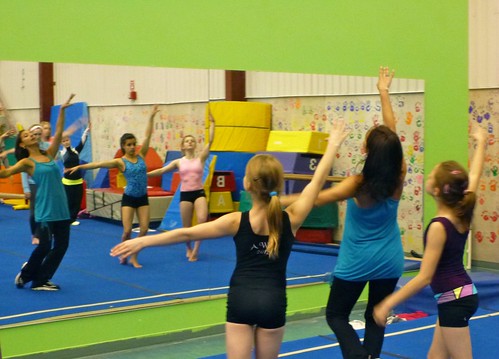
Gymnastics Clinic Red DeerImage by Rick McCharles

There’s a strange mix of expectation and freedom that yields the highest quality learning. It’s not enough to simply give freedom to your kids. Sometimes they drown in it.

“Mom, I can’t think of anything to do.”

“But how does this game work? I just want to understand the rules.”

“I can’t hit the ball. What am I doing wrong?”

“Where do I start? There’s too much to read and too many ideas to think about.”

“How can I grow up to be an actress?”

Kids want answers to these kinds of questions. A coach will help a baseball player to know what is going on with that swing. It’s not interference to give feedback and help. It’s too much freedom to simply say, “Keep swinging. It’s up to you!”

An aspiring actress needs to test her stage presence. She needs opportunities. These don’t come by singing in the living room alone.

Kids (all of us) want some structure. They want some hand holds or guard rails. They want scaffolding. The far extreme of this “freedom” continuum is the distorted view of unschooling where parental involvement looks like parental interference. Parents are so hands-off, sometimes kids don’t even know their options!

On the other end of the continuum, though, are parents who are so involved and invested, they withhold dinner and scream at their son until he finally masters two-handed piano playing…and winds up in Carnegie Hall at age 16.

We wonder: Is that the right route? After all, Carnegie Hall is a good gig if you can get it!

I often find the word “balance” an irritant (please quit telling me to live a balanced life—I just want to live a life and not have to “balance” it all the time). So I am not going there. But, I don’t want us to one day scream bloody murder at our kids and on the other day, abandon them to their own devices, unwilling to help them out of a boredom jam.

What I want to say is this:

Expectation can be either an enormous motivator and support when becoming all you are meant to be, or it can defeat and tear down the fledgling aspirant. The amount and the type of pressure determine whether or not your child will flourish and thrive, or shrivel and withdraw.

Just because a child achieves a goal with or without undue pressure is not a validation of either extreme methodology either. Underneath is a relationship to you—and to the self—that is being daily created behind the achievements.

What we want is bold and big:

Personal accomplishment combined with healthy self confidence and relaxed, trusting relationship with the parents.

How do we get there?

We feel most connected to each other when we are in a relationship that creates emotional safety. A child’s performance or lack of achievement doesn’t determine whether your kids feel loved or safe, whether a parent smiles or hugs, whether a parent shows pride and admiration.

To that end, parents have to pay attention to their kids. They supply resources, answer questions, provide imagined scenarios, and create possibilities.

Parents know how to find what is “out there” and how to bring that to children. Parents can help match a child to the information, opportunities, instructors, tools, and environments that facilitate growth in a child’s chosen interest.

For example, when my kids got fascinated with vintage dance because of the BBC/A&E Pride and Prejudice series, I hunted for a dance studio in Cincinnati that taught vintage dance. Found one. Couldn’t afford it. Figured out how to get my kids in for free (we spent Monday afternoons stuffing mailboxes with dance flyers, come wind, rain, hail and snow!). They danced.

It was not enough to know they wanted to dance. Nor was it enough to leave them to it on our back deck. They needed my help to find lessons so they really were learning to dance! That’s the right kind of support.

When they didn’t want to go to class, I still took them because of the commitment and the need to not get behind for the big ball at the end! I helped them fulfill their commitment. We stuffed those mailboxes every week, even when no one felt like it. That’s the right kind of pressure.

I didn’t, however, expect them to go on to be competitive vintage dancers. That kind of pressure would have been my agenda, and not theirs.

My job was to support a vision, and an enthusiasm, and a commitment.

Their job was to show up, to participate, to “pay” for the opportunity and privilege, and to enjoy it. They could determine if one season sated the curiosity or led to new aspirations.

As you work with your children, keep in mind these two aspects of parenting:

1) Freedom to dream big, to have desires, to explore unusual interests, to find ways to bring those dreams to life.

2) Involvement that provides resources, gentle accountability (within reason—if the experience turns out to be one that is crushing the child’s spirt, dump it!), and helpful support (payment, driving, attending events, providing the right supplies…).

The only pressure a child should feel is the pressure to live up to his or her potential and to realize his or her dreams. That comes from within. You can’t create it or induce it in the child.

You must not put on pressure that comes from your agenda. That’s when you cross the line.

Your job is to match your child’s enthusiasm—don’t do more for the child than the child is willing to do for self, but don’t limit your child by ignoring how you can help, since you are the adult with connections, money, and resources.

The right kind of freedom and expectation.

The right kind of pressure.

Cross-posted on facebook.

Posted in Homeschool Advice, Parenting | Comments Off on The right kind of pressure

« Older Entries
Newer Entries »
  • Search the Blog

  • Julie Bogart
  • Welcome, I’m Julie Bogart.

    I’m a homeschooling alum -17 years, five kids. Now I run Brave Writer, the online writing and language arts program for families. More >>

    IMPORTANT: Please read our Privacy Policy.

  • New to Brave Writer? START HERE

  • FREE Resources

    • 7-Day Writing Blitz
    • Brave Writer Lifestyle Program
    • Brave Writer Sampler: Free Sample Products
    • Freewriting Prompts
    • Podcasts
  • Popular Posts

    • You have time
    • How writing is like sewing
    • Best curriculum for a 6 year old
    • Today's little unspoken homeschool secret
    • Do you like to homeschool?
    • Don't trust the schedule
    • You want to do a good job parenting?
    • If you've got a passel of kids
    • You are not a teacher
    • Natural Stages of Growth in Writing podcasts
  • Blog Topics

    • Brave Learner Home
    • Brave Writer Lifestyle
    • Classes
    • Contests/Giveaways
    • Friday Freewrite
    • High School
    • Homeschool Advice
    • Julie's Life
    • Language Arts
    • Movie Wednesday
    • Natural Stages of Growth
    • One Thing Principle
    • Our Team
    • Parenting
    • Philosophy of Education
    • Podcasts
    • Poetry Teatime
    • Products
    • Reviews
    • Speaking Schedule
    • Students
    • Writing about Writing
    • Young Writers
  • Archives

  • Brave Writer is a participant in the Amazon Services LLC Associates Program, an affiliate advertising program designed to provide a means for sites to earn advertising fees (at no extra cost to you) by advertising and linking to amazon.com

    Content © Brave Writer unless otherwise stated.

What is Brave Writer?

  • Welcome to Brave Writer
  • Why Brave Writer Works
  • About Julie
  • Brave Writer Values
  • Frequently Asked Questions
  • Speaking Schedule

Brave Writer Program

  • Getting Started!
  • Stages of Growth in Writing
  • The Brave Writer Program
  • For Families and Students
  • Online Classes
  • Brave Writer Lifestyle

…and More!

  • Blog
  • Classroom
  • Store
  • Books in Brave Writer Programs
  • Contact Us
  • Customer Service
  • Brave Writer Staff
© 2026 Brave Writer
Privacy Policy
Children's Privacy Policy
Help Center