[Podcast #356] Parenting Strategies or Teaching Tactics
What if the missing ingredient in your homeschool isn’t a better curriculum, but a bigger toolkit for teaching?
When kids resist a lesson, it’s easy to reach for familiar parenting strategies: consequences, bargaining, reminders, and demands for cooperation. But learning asks something different of us.
We need teaching tactics that spark:
- curiosity,
- invite collaboration,
- leave room for contemplation,
- and celebrate real growth.
On today’s Brave Writer podcast episode, we explore playful, practical ways to make math, history, writing, and other subjects more meaningful, while helping our kids develop genuine ownership of what they learn.
Tune in and discover how to trade “Come on, you guys!” for richer learning experiences.
Show Notes
Many of us begin homeschooling with a beautiful picture in our heads. We’ve researched the curriculum, gathered books, and planned activities and field trips. We sit down to offer our children this feast of learning and expect them to recognize how wonderful it is.
Then somebody starts poking a sibling. Someone decorates the math worksheet instead of completing it. The dog suddenly becomes much more interesting than phonics.
And we hear ourselves saying, “Come on, you guys!”
That moment points to an important distinction: parenting strategies and teaching tactics are not the same thing.
Cooperation Isn’t the Same as Learning
As parents, we already have strategies for getting through daily life. We set timers, offer consequences, and remind our child that shoes have to go on before we leave the house.
Those tools are designed to produce cooperation with an adult agenda.
Education requires another set of skills. Our job as parent educators is to provoke curiosity, make abstract ideas meaningful, help our children practice what they’re learning, and create conditions where understanding can grow.
A completed worksheet may show cooperation. It doesn’t necessarily show learning.
So what can we do instead?
We can start with four capacities: curiosity, collaboration, contemplation, and celebration.
Curiosity
Before asking, “How do I make my child do this?” try asking, “What would make my child want to know this?”
Division gets more interesting when we’re dividing M&Ms fairly. Math becomes useful when a video game requires us to calculate how much a crop will cost and what we can earn by selling it. Ancient Greece becomes inviting through mythology, museum exhibits, movies, stories, or games.
Every child has different doors into learning. Our work is to look for them.
Collaboration
Helping is not cheating.
Think about how many times we help children learn to tie their shoes. We don’t demonstrate it once and announce that they should now be independent forever.
Academic skills work the same way. Children may master one level and need us again when the work becomes longer or harder.
Just because a child can walk doesn’t mean we refuse them a stroller at Disneyland. Ability and stamina are different things.
Contemplation
Learning needs room to marinate.
Read the comic book, then make a comic. Visit the museum, then draw the painting you remember. Talk about geography, then copy the names of the continents.
And leave some empty space.
When every quiet moment becomes an opportunity to assign another task, children lose time to think about what they have already encountered. Conversation, reflection, and even loafing can be part of an education.
Celebration
Finally, notice what happened.
Not generic praise. Not simply, “Good job!”
Notice the specific thing that grew: “You wrote three sentences today.” “Look at those R’s.” “You stayed with that problem even when it was hard.”
We can celebrate the planting of the seed, not only the full sunflower.
That shift changes the atmosphere of learning. Instead of relying on strategies that enforce an academic agenda, we begin collecting teaching tactics that help our children become curious, engaged, thoughtful learners.
That is the professional development of homeschooling.
Resources
- Registration is open now for Middle School Writing: Nonfiction Projects and many other Brave Writer classes!
- Interested in helping the Library of Congress transcribe old documents? Sign up here!
- Start a free trial of CTCmath.com to try the math program that’s sure to grab and keep your child’s attention
- Find Jim Weiss’s Greek Myths CD along with our favorite readalouds and nonfiction in the Brave Writer Book Shop
- Visit Julie’s Substack to find her special podcast for kids (and a lot more!)
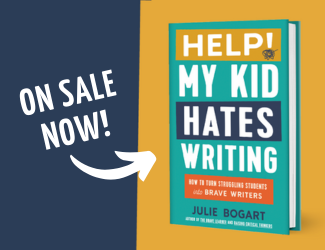
- Purchase Julie’s new book, Help! My Kid Hates Writing
- Melissa’s books make great readalouds—and there are Darts for The Prairie Thief and The Nerviest Girl in the World.
- Find community at the Brave Learner Home
- Learn more about the Brave Writer Literature & Mechanics programs
- Subscribe to Julie’s Substack newsletters, Brave Learning with Julie Bogart and Julie Off Topic, and Melissa’s Catalog of Enthusiasms
- Sign up for our Text Message Pod Ring to get podcast updates and more!
- Send us podcast topic ideas by texting us: +1 (833) 947-3684
- Interested in advertising with us? Reach out to media@bravewriter.com
Connect with Julie
- Instagram: @juliebogartwriter
- Threads: @juliebogartwriter
- Bluesky: @bravewriter.com
- Facebook: facebook.com/bravewriter
Connect with Melissa
- Website: melissawiley.com
- Substack: melissawiley.substack.com
- Instagram: @melissawileybooks
- Bluesky: @melissawiley.bsky.social
Produced by NOVA