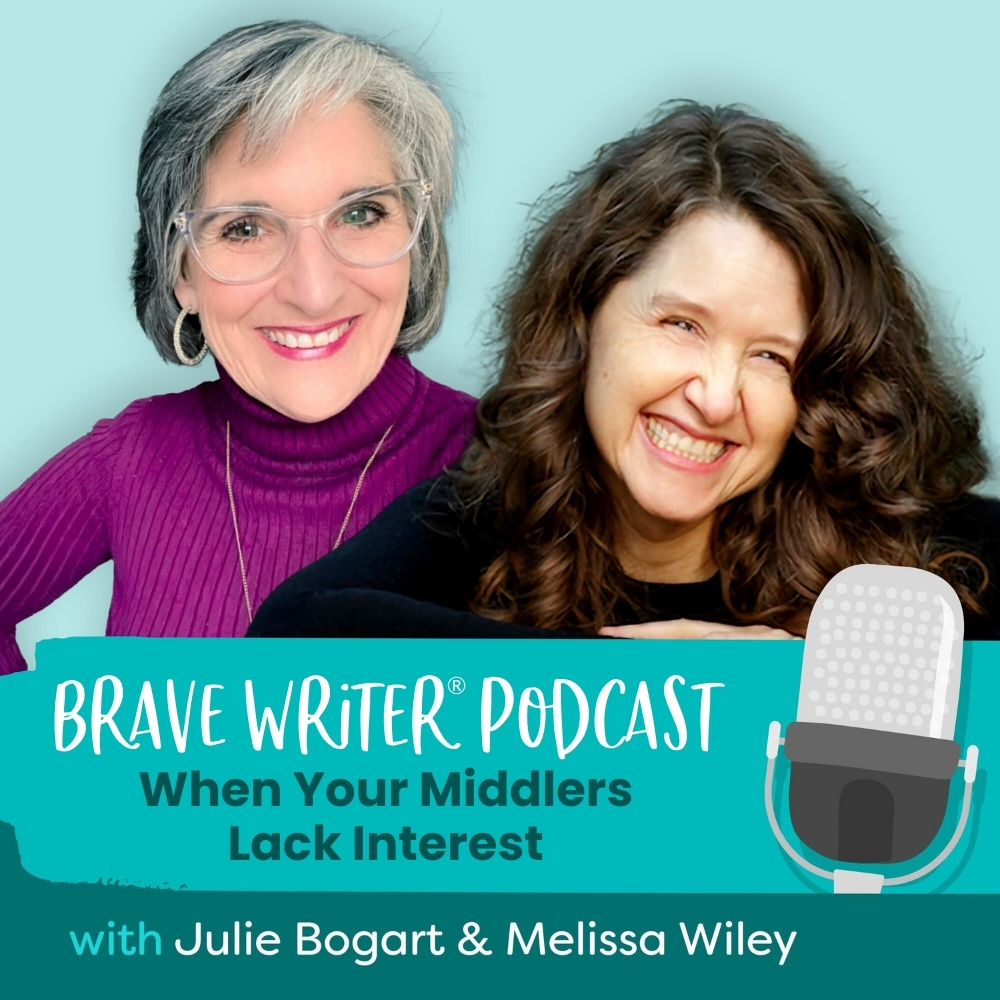
[Podcast #316] When Your Middlers Lack Interest
What do we do when our tweens and teens don’t seem “into” anything?
In this Brave Writer podcast episode, we explore how to revive interest, curiosity, and motivation in the middle school years—without forcing artificial enthusiasm.
We talk about:
- why middlers may seem disengaged,
- how risk and adventure replace the “magic” of early childhood learning,
- and how deep dives, conversation, boredom, and flexibility can open doors to authentic passion.
We also share practical scripts, examples from our own families, and tools for nurturing critical thinking and connection.
Show Notes
Middle school can feel like unfamiliar territory for many homeschoolers. The cozy magic that carried us through the elementary years suddenly seems mismatched to our tweens, who often appear restless, bored, or unsure about what interests them. As academic expectations rise, we may feel pressure to keep everything moving forward, even when our kids seem to stall. But the middle years are ripe with possibility if we’re willing to rethink how learning works.
Risk and Adventure Replace Early-Education Magic
One thing we’ve noticed is that the enchantment of the early years often comes from surprise and mystery: the twinkle lights, the themed read-alouds, the cozy writing moments. But tweens and teens are wired for something different. They’re ready for risk and adventure. Not necessarily cliff jumping or grand excursions—though sometimes that too—but the intellectual and emotional risks that come with forming opinions, exploring new worlds, and stepping outside familiar perspectives.
Rather than expecting them to declare a clear passion, we make space for them to discover one. For many kids, interest begins quietly. It emerges through consumption—books, films, fandoms, video games, music—long before it shows up as creative output. We sometimes forget that mastering a subject begins with taking in mountains of input. College students and graduate-level scholars spend years consuming before producing original work. When our middlers are devouring books or revisiting a favorite hobby, they are building vocabulary, context, and insight that later become the foundation of mature thinking.
Conversation as a Catalyst for Understanding
We also find that conversation fuels understanding. When we listen, truly listen, to our kids talk about what they love, they refine their ideas in real time. Some families build this into group activities like movie nights or book clubs; others find it easier to talk through a WhatsApp thread or emails with grandparents. However it happens, the back-and-forth deepens thinking and strengthens connection.
But sometimes, before interest emerges, there’s boredom. In a world full of instant entertainment, boredom can feel like a problem. But it’s actually the fertile soil of creativity. When we carve out device-free space and keep enticing materials accessible—binoculars, art supplies, maps, kitchen tools—we give our kids the freedom to wander mentally and physically. That meandering often leads to unexpected discoveries. The child who seems apathetic one week may suddenly be whittling wood, researching constellations, or organizing a geocaching route the next.
Inviting Kids Into the Process
The secret is transparency. Instead of changing course quietly, we invite our kids into the process: “I’ve noticed we’re all feeling a little stuck. I’d love to experiment with giving ourselves some free space every day to explore ideas or interests. It might feel boring at first, but I think something good could come out of it.” When we model curiosity and honesty, our kids feel respected and more willing to take their own risks.
The Power of the Middle School Transition
Middle school isn’t a dead zone of interest. It’s a transition zone. A place where kids shed childhood patterns and begin shaping who they are. When we provide spaciousness, conversation, and gentle encouragement, we help them step into the adventurous, risk-taking thinkers they’re becoming. And along the way, we rediscover a little of our own curiosity, too.
Resources
- Listen to our interview with Chris Balme, and find his book Challenge Accepted: 50 Adventures to Make Middle School Awesome in the Brave Writer Book Shop
- Brave Writer class registration is open!
- Visit Julie’s Substack to find her special podcast for kids (and a lot more!)
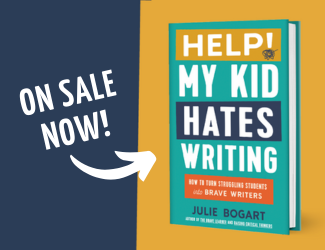
- Purchase Julie’s new book, Help! My Kid Hates Writing
- Find community at Brave Learner Home
- Learn more about the Brave Writer Literature & Mechanics programs
- Start a free trial of CTCmath.com to try the math program that’s sure to grab and keep your child’s attention
- Subscribe to Julie’s Substack newsletters, Brave Learning with Julie Bogart and Julie Off Topic, and Melissa’s Catalog of Enthusiasms
- Sign up for our Text Message Pod Ring to get podcast updates and more!
- Send us podcast topic ideas by texting us: +1 (833) 947-3684
Connect with Julie
- Instagram: @juliebravewriter
- Threads: @juliebravewriter
- Bluesky: @bravewriter.com
- Facebook: facebook.com/bravewriter
Connect with Melissa
- Bluesky: @melissawiley.bsky.social
- Website: melissawiley.com
- Substack: melissawiley.substack.com
- Instagram: @melissawileybooks
Produced by NOVA