[Podcast #336] Do You Suffer From an Adventure Deficit?
What if the crankiness in your homeschool isn’t a behavior problem at all, but an adventure deficit?
In this Brave Writer podcast episode, we explore how too much routine can flatten a family’s energy and how a little surprise, novelty, and wonder can bring learning back to life. We share simple ways to add adventure at home, outside, in literature, in language, and even on rainy days, plus ideas for building an “adventure list” before you need one.
Along the way, we talk about wonder walls, theater games, jump rope, gardening, punctuation, and the hilarious flow chart that asks the all-important question: “But did you die?” Listen in, then come share your own adventure ideas with us.
Show Notes
When Homeschooling Needs More Adventure
For many of us, learning was shaped by routine: sit down, do the assignment, finish the lesson, move on. There is comfort in rhythm, and children do benefit from knowing what to expect.
But routine is only part of a healthy learning life.
Children also need surprise. They need mystery, movement, novelty, and the feeling that something interesting might happen. They need moments that wake them up to the world again. When those moments disappear, homeschool can start to feel flat, even when everything is technically going fine.
That shift matters more than we sometimes realize.
Adventure is already part of learning
One of the gifts of homeschooling is that we are not limited to a classroom schedule or a narrow idea of what counts as education. Learning can happen in the kitchen, in the backyard, on a walk, during a thunderstorm, or while trying something that feels just a little unexpected.
A child pouring milk onto a plate and watching colors spread through it is learning. A child planting seeds in a clear cup and checking daily for roots is learning. A child jumping rope, making a paper chain of activities, or comparing old cartoons to modern ones is learning too.
These moments may not look like formal lessons, but they are full of attention, memory, and connection. They ask something of the child. They invite participation. They make room for wonder.
When we notice that, we begin to see adventure not as a break from learning, but as one of the ways learning comes alive.
Make room for surprise and discovery
Children understand more deeply when they are engaged by something real. Sometimes that means touching, making, testing, building, or observing. Sometimes it simply means doing something different enough to restore energy.
That might look like drawing with washable markers on bathtub walls, going outside in the rain with boots and buckets, using wet sidewalk chalk, or visiting a part of town you have never explored before. It might mean acting out a fable, recording a silly voiceover for the family pet, baking something special on a rainy afternoon, or turning a question into an experiment.
The point is not to invent elaborate activities every day. It is to notice when the atmosphere needs fresh air.
Children often show us when that moment has arrived. The clues are familiar: glazed eyes, bickering, fidgeting, sudden irritability, resistance to every small task. We may assume we are dealing with bad attitudes or lack of discipline. Sometimes we are simply seeing what happens when a family needs a little more adventure.
Wonder matters as much as structure
Of course, children need rhythm. Family life cannot run on novelty alone. Routines help us return to what matters, and many parts of learning do require consistency, repetition, and follow-through.
But structure works best when it supports life rather than flattening it.
Adventure brings back the sense that learning is connected to the real world. It invites children to ask questions, take risks, notice details, and stay open to what they do not yet know. A good question can do as much as a good lesson. A surprising moment can open more than an explanation.
This is why it helps to collect ideas before you need them. An adventure list, a jar of activity slips, or a wall of questions can give you somewhere to turn when the mood in your homeschool begins to sag. You do not have to create magic on demand. You can prepare for it.
Create an environment that welcomes curiosity
Sometimes the activity itself is simple, but the invitation makes the difference.
A candle at the table. A tray of face paint. A stack of Post-it notes for questions. A jump rope on the porch. A new walking route. A bowl of art supplies. A family challenge to notice something strange, beautiful, or unexplained.
These small choices shift the emotional atmosphere. They tell children that learning is not only about finishing. It is also about exploring.
We do not need to make every day dramatic. But we can make room for enchantment.
Help children experience learning as a living thing
What we want is bigger than cooperation. We want children who are alert to the world, willing to wonder, and able to follow a question into deeper understanding. We want them to know that learning is not confined to books and assignments. It lives in observation, experimentation, conversation, creativity, and play.
When we nurture adventure, we are doing more than adding fun to the week. We are helping our children reconnect with energy, curiosity, and delight.
Homeschool does not always need a new curriculum.
Sometimes it needs a question, a rainy walk, a kitchen experiment, a theater game, a jump rope, a wall of questions, or a child who wants to know what will happen if.
Resources
- Check out the “Did You Have a Good Adventure?” flow chart at Semi-Rad.com
- Find Roots, Shoots, Buckets, and Boots and Whatever the Weather: Science Experiments and Art Activities That Explore the Wonders of Weather in the Brave Writer Book Shop
- Brave Writer class registration is open!
- Visit Julie’s Substack to find her special podcast for kids (and a lot more!)
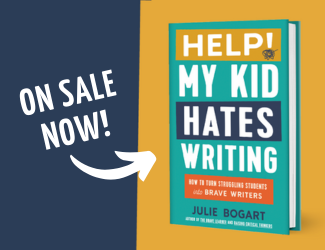
- Purchase Julie’s new book, Help! My Kid Hates Writing
- Find community at the Brave Learner Home
- Learn more about the Brave Writer Literature & Mechanics programs
- Start a free trial of CTCmath.com to try the math program that’s sure to grab and keep your child’s attention
- Subscribe to Julie’s Substack newsletters, Brave Learning with Julie Bogart and Julie Off Topic, and Melissa’s Catalog of Enthusiasms
- Sign up for our Text Message Pod Ring to get podcast updates and more!
- Send us podcast topic ideas by texting us: +1 (833) 947-3684
- Interested in advertising with us? Reach out to media@bravewriter.com
Connect with Julie
- Instagram: @juliebogartwriter
- Threads: @juliebogartwriter
- Bluesky: @bravewriter.com
- Facebook: facebook.com/bravewriter
Connect with Melissa
- Website: melissawiley.com
- Substack: melissawiley.substack.com
- Instagram: @melissawileybooks
- Bluesky: @melissawiley.bsky.social
Produced by NOVA