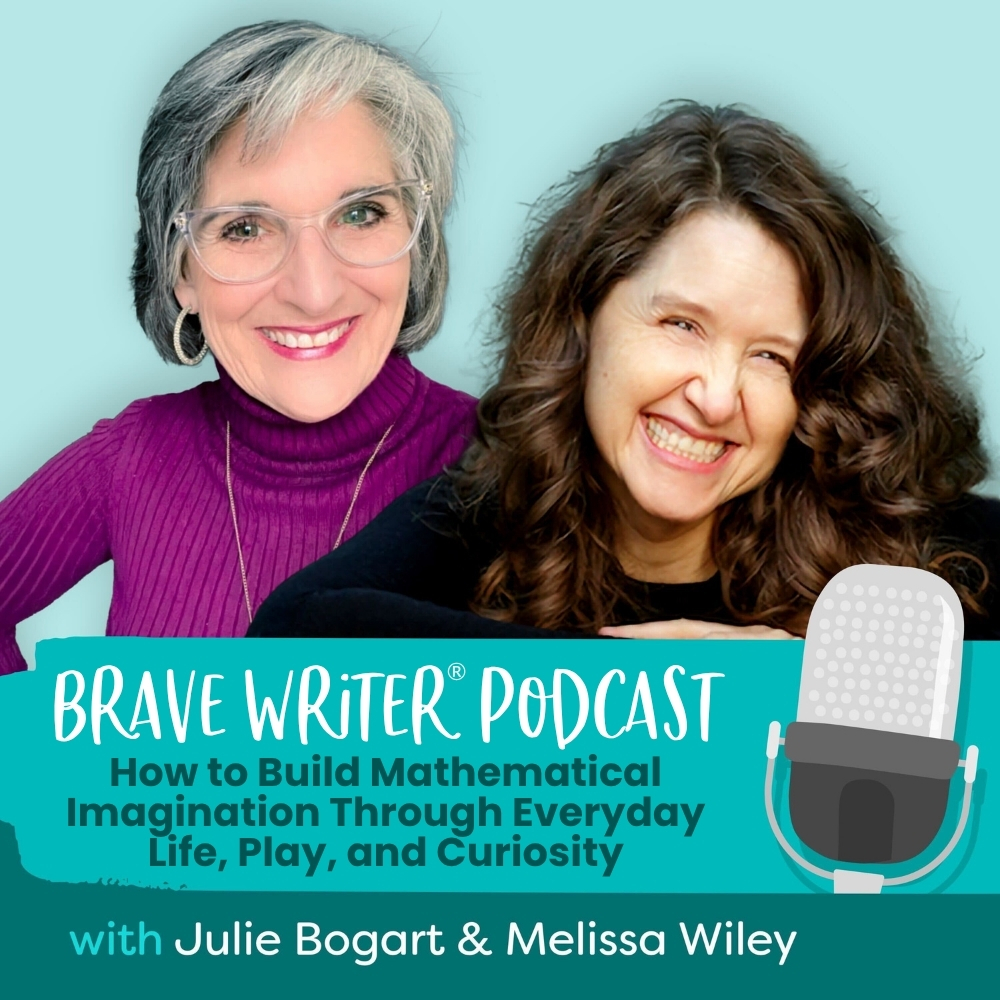
[Podcast #335] How to Build Mathematical Imagination Through Everyday Life, Play, and Curiosity
What if math felt less like drudgery and more like discovery?
In this Brave Writer podcast episode, we explore “mathematical imagination” and the many ways math is already alive in everyday family life. We talk about counting, measuring, predicting, sports, video games, art, nature, and how curiosity can turn numbers into something meaningful.
We also share practical ways to make formal math time more inviting, from manipulatives and mystery-based activities to math tea times and even bubblegum math. If you’ve ever wanted to help your child experience math as a language for describing the world, this conversation is for you.
Tune in, then come tell us what math looks like in your home.
Show Notes
For many of us, math was taught as a subject of procedures: memorize the facts, follow the steps, get the answer. It often felt detached from daily life, as though numbers only mattered on worksheets and tests.
But math is far more alive than that.
Math is one of the ways we describe the world. It helps us make sense of time, quantity, distance, proportion, patterns, and change. When we begin to see it that way, math becomes less about performance and more about perception. It becomes a way of noticing.
That shift can change everything for our kids.
Math is already happening
One of the gifts of homeschooling is that we are not limited to a single hour of “math time.” We live with math all day long. We check the clock. We divide food fairly. We estimate how long something will take. We compare measurements, track the weather, count steps, budget money, and notice patterns in nature.
Children encounter mathematical ideas long before they can explain them formally. A young child counting toes, sorting objects, or asking whether thumbs are fingers is already exploring categories, quantity, and comparison. A child measuring sunflower growth or guessing how many windows are in the house is practicing estimation and observation. These are not distractions from math. They are the beginning of it.
When we treat these moments as meaningful, we help our children build a relationship with math that starts in curiosity rather than anxiety.
Make math tangible and relevant
Children understand ideas more deeply when they can touch them, test them, and connect them to something they care about.
That might look like using edible manipulatives for multiplication, baking to explore fractions and measurement, or weighing ingredients on a kitchen scale. It might look like comparing Fahrenheit and Celsius, noticing patterns in flower petals, or graphing how many leaves fall from a tree over the course of a week.
It may also show up in places we do not immediately recognize as academic. A child playing Minecraft may be calculating resource efficiency. A child managing a farm simulation game may be comparing rates of return. A sports-loving child may already understand scoring systems, percentages, and statistical comparisons better than we realize.
The point is not to force a lesson onto every interest. It is to notice where math already matters and help our children make that connection consciously.
Wonder matters as much as practice
Of course, children do need practice. Some parts of math require repetition, concentration, and patience. Not every lesson will feel magical.
But understanding grows best when it is supported by meaning.
When children can see what math is for, the formal work begins to make more sense. The symbols are no longer floating in space. They are attached to real experiences, real questions, and real discoveries.
This is why prediction, mystery, and surprise can be so powerful. Estimating how many beans are in a jar, wondering whether your wingspan matches your height, or mapping the solar system across your neighborhood invites children into math through fascination. They want to know the answer because the question belongs to them.
That is a very different posture than simply finishing a page.
Create an environment that invites attention
Sometimes the activity itself is hard. When that happens, we can still make the experience more welcoming.
A special snack, a candle, a clipboard, a favorite seat by the window, a cup of tea, a small ritual before beginning. These quiet choices can transform the emotional atmosphere around math. Children are more willing to stay with challenging work when the environment feels calm, personal, and pleasant.
We do not need to make every lesson entertaining. But we can make room for comfort, dignity, and delight.
Help children see the world mathematically
What we want is bigger than correct answers. We want children to notice patterns, ask questions, compare systems, make predictions, and understand relationships. We want them to see that math is not a disconnected school subject but one of the tools humans use to interpret reality.
When we nurture mathematical imagination, we are doing more than teaching arithmetic. We are helping our children become more observant, more thoughtful, and more confident in the face of complexity.
Math does not have to begin with a workbook.
It can begin with a question, a game, a measuring tape, a recipe, a sky full of stars, or a child who wants to know why.
Resources
- Explore the Journey North Mystery Class archives
- Encounter solar system planet sizes and distances in this fun activity
- Find our favorite books for kids and parents in the Brave Writer Book Shop
- Visit Julie’s Substack to find her special podcast for kids (and a lot more!)
- Purchase Julie’s newest book, Help! My Kid Hates Writing
- Find community at the Brave Learner Home
- Learn more about the Brave Writer Literature & Mechanics programs
- Start a free trial of CTCmath.com to try the math program that’s sure to grab and keep your child’s attention
- Subscribe to Julie’s Substack newsletters, Brave Learning with Julie Bogart and Julie Off Topic, and Melissa’s Catalog of Enthusiasms
- Sign up for our Text Message Pod Ring to get podcast updates and more!
- Send us podcast topic ideas by texting us: +1 (833) 947-3684
- Interested in advertising with us? Reach out to media@bravewriter.com
Connect with Julie
- Instagram: @juliebogartwriter
- Threads: @juliebogartwriter
- Bluesky: @bravewriter.com
- Facebook: facebook.com/bravewriter
Connect with Melissa
- Website: melissawiley.com
- Substack: melissawiley.substack.com
- Instagram: @melissawileybooks
- Bluesky: @melissawiley.bsky.social
Produced by NOVA