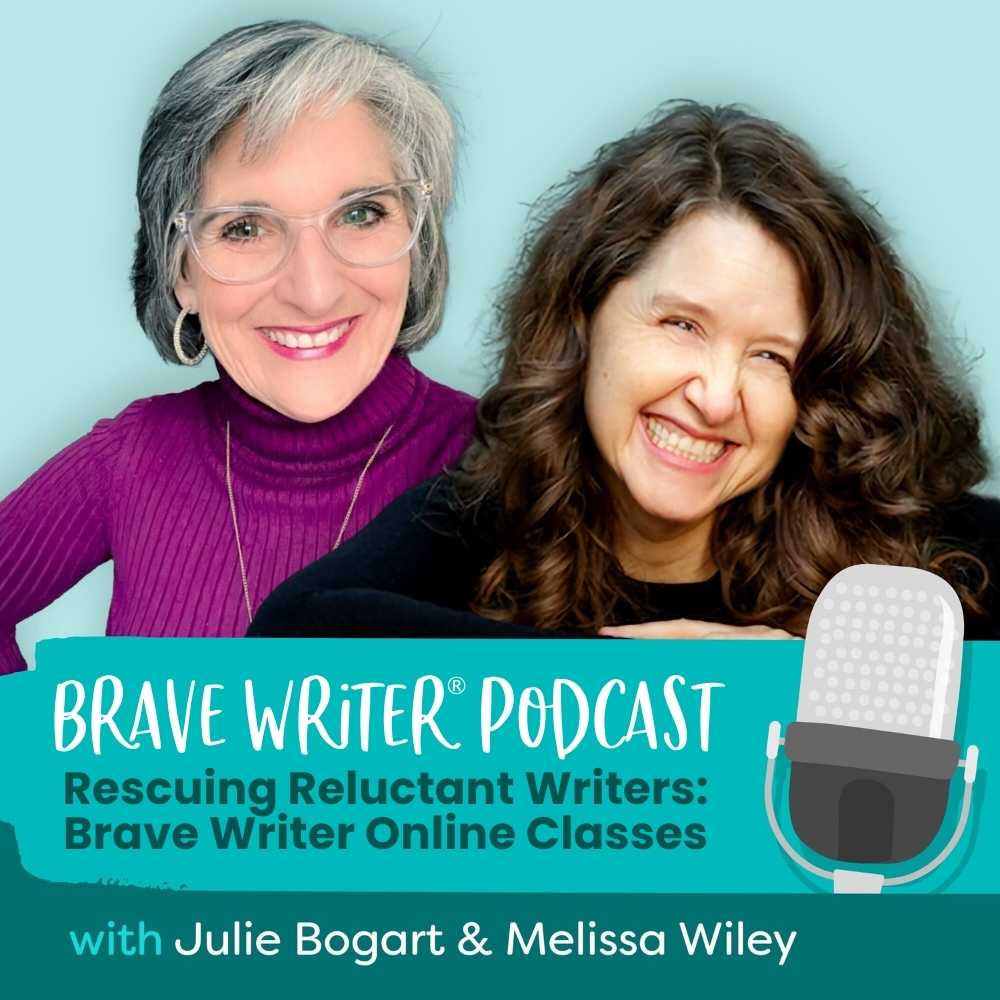
[Podcast #334] Rescuing Reluctant Writers: Brave Writer Online Classes
What if an online writing class didn’t mean Zoom fatigue, rigid schedules, or one more thing to manage?
In this Brave Writer podcast episode, Melissa Wiley talks with Kirsten Merryman about what makes Brave Writer’s online classes so different: asynchronous discussions, text-based coaching, warm instructor feedback, and a structure that makes room for all kinds of learners.
We explore:
- how real writing growth happens,
- why parents learn right alongside their kids,
- and which classes might be the best fit for your family, from Story Switcheroo to Essay Prep.
Kirsten Merryman is Brave Writer’s Vice President of Operations and former director of online classes. She is also a longtime homeschooler, writing coach, and curriculum creator who has helped shape Brave Writer’s approach to supporting both parents and young writers.
Join us to discover how writing support can feel personal, practical, and surprisingly freeing.
Show Notes
What Makes Writing Instruction Actually Work?
Every homeschooling parent has felt it: your child has something interesting to say, but the moment writing begins, the struggle starts.
What should be an act of expression can quickly turn into frustration, avoidance, or tears. It can feel tempting to focus on the obvious fixes, grammar, punctuation, spelling, structure. But what if strong writing begins somewhere else entirely?
The truth is, writing growth doesn’t start with correction. It starts with connection.
When children feel safe to put words on the page, when they know a reader is genuinely interested in what they mean, writing begins to open up. That shift can change everything.
Writing Is More Than Mechanics
It’s easy to think of good writing as clean writing.
We want our kids to use correct punctuation, organize their thoughts, vary sentence structure, and produce polished final drafts. Those skills matter. They help writing communicate clearly.
But mechanics are not the heart of writing.
The heart of writing is having something to say and believing it is worth saying. Children need space to discover their ideas before they can refine them. They need to experience writing as communication, not just as a performance of correctness.
That’s why messy first drafts matter. Real writers do not sit down and produce polished work in one pass. They draft, rethink, revise, and shape their language over time.
When we expect children to do everything at once, think of something meaningful, express it clearly, spell it correctly, punctuate it properly, and organize it neatly, we often make writing feel heavier than it needs to be.
Response Builds Confidence
One of the most powerful things we can offer young writers is a real reader.
When someone responds to a child’s writing with interest, something shifts. A comment like “This made me laugh,” or “I can really picture this,” or “You taught me something here,” does more than encourage. It helps the child see that writing has a purpose.
They are not just completing an assignment. They are reaching another human being.
That kind of response builds confidence. It also teaches. When children hear what is working in their writing, they begin to recognize their own strengths. They start to notice voice, detail, humor, rhythm, and insight.
This is often more useful at the beginning than a long list of corrections.
Once a child feels invested in their own words, revision starts to make sense. Improving the writing no longer feels like punishment. It feels like making something meaningful stronger.
Practical Ways to Support Writing at Home
Small shifts in how we respond to writing can make a big difference.
One helpful practice is to read as a reader first. Before correcting anything, notice what stands out to you.
You might:
- point out a vivid word or phrase
- mention a line that made you smile
- reflect back an idea that felt strong or surprising
- ask a curious question about something they wrote
Another useful approach is to separate drafting from editing. Let your child get the ideas out first. Save grammar, spelling, and punctuation for later passes.
It also helps to let children write about topics they truly care about. When a child is invested in the subject, they are far more willing to stay with the process.
Even reluctant writers often have strong opinions, deep interests, or a quirky sense of humor waiting to show up on the page.
The Real Goal
Many of us were taught to approach writing as correction first. We learned to look for what was wrong before we noticed what was alive.
But strong writing instruction begins by helping children experience themselves as writers.
That means noticing effort. It means honoring risk. It means looking for the spark in a rough draft and trusting that polish can come later.
Our goal is not simply to produce error-free papers.
Our goal is to help children develop fluency, ownership, and confidence so they can grow into writers who know they have something to say.
And when that happens, the mechanics become easier to teach, because the child is no longer just trying to finish.
They are trying to communicate.
Resources
- Explore our upcoming Brave Writer class schedule
- Got questions about classes? Reach out to us at help@bravewriter.com
- Find our favorite books for kids and parents in the Brave Writer Book Shop
- Visit Julie’s Substack to find her special podcast for kids (and a lot more!)
- Purchase Julie’s new book, Help! My Kid Hates Writing
- Find community at the Brave Learner Home
- Learn more about the Brave Writer Literature & Mechanics programs
- Start a free trial of CTCmath.com to try the math program that’s sure to grab and keep your child’s attention
- Subscribe to Julie’s Substack newsletters, Brave Learning with Julie Bogart and Julie Off Topic, and Melissa’s Catalog of Enthusiasms
- Sign up for our Text Message Pod Ring to get podcast updates and more!
- Send us podcast topic ideas by texting us: +1 (833) 947-3684
- Interested in advertising with us? Reach out to media@bravewriter.com
Connect with Julie
- Instagram: @juliebogartwriter
- Threads: @juliebogartwriter
- Bluesky: @bravewriter.com
- Facebook: facebook.com/bravewriter
Connect with Melissa
- Website: melissawiley.com
- Substack: melissawiley.substack.com
- Instagram: @melissawileybooks
- Bluesky: @melissawiley.bsky.social
Produced by NOVA