[Podcast #329] Accidental vs. On-Purpose Learning
Are you wondering if you’ve done “enough” this year? What if the real question isn’t about subjects completed—but about the atmosphere you’re creating?
Melissa developed a simple framework to help her notice what was filling her children’s days. She called it the “Rule of Six”:
- Living Books
- Encounters with Beauty
- Meaningful Work
- Imaginative Play
- Big Ideas to Ponder and Discuss
- Reflection
This week on the Brave Writer podcast, we revisit this concept as a method of filling our children’s days with living books, beauty, meaningful work, imaginative play, big ideas, and reflection. From accidental learning to on-purpose instruction, we explore how to balance immersion with explicit teaching—so our kids gain both joy and skill.
If you’re feeling that mid-year wobble, this conversation will help you notice what’s thriving, what’s missing, and how to move forward with clarity.
Show Notes
In homeschooling, we often feel pulled between two extremes. On one side, there’s the belief that if children are immersed in rich experiences, learning will unfold naturally. On the other, there’s pressure to replicate school at home—complete with structured lessons and measurable outcomes. The tension between those poles can leave us wondering: Are we doing enough?
Over the years, we’ve come to appreciate a both/and approach.
The Rule of Six: A Framework for a Full Life
Melissa developed what she calls the “Rule of Six” as a way to notice what was shaping her children’s days. It wasn’t a schedule. It wasn’t a curriculum. It was a way of life.
Here are the six elements:
- Living Books: Books written by real authors with passion and depth—not dry, committee-written textbooks.
- Encounters with Beauty: Art on the walls. Music in the background. Time in nature. Beauty as a daily companion.
- Meaningful Work: Work that matters. Caring for the home. Building academic skills. Effort that carries purpose, not just activity.
- Imaginative Play: Forts. Backyard soccer. Dress-up. Creative immersion. Space to explore without constant direction.
- Big Ideas to Ponder and Discuss: Narration. Conversation. Reflecting on books, experiences, and questions. Talking through what we’re learning.
- Reflection: Ending the day with gratitude, prayer, or simple review. Noticing where those other five elements showed up.
This list isn’t meant to create pressure. It’s a tool for noticing. If something feels thin, we can lean into it. If something is thriving, we can celebrate it.
Children Are Always Learning
Children absorb math through board games. They build vocabulary through read-alouds. They develop historical understanding through novels and documentaries. This kind of accidental learning is powerful. It grows out of curiosity, connection, and lived experience.
But some skills do not reliably emerge on their own.
No child accidentally masters long division. Most don’t spontaneously understand revision in writing. Learning to play the cello—or to write a cohesive essay—requires intentional guidance.
The key is not rigid schooling. The key is appropriate support.
Immersion First, Then Instruction
We like to think of it this way: immersion first, then instruction.
When children are saturated in a subject—reading myths, visiting museums, watching films—they eventually want to create something of their own. That’s the moment to offer tools. Show them how structure works. Demonstrate revision. Model technique.
Instruction lands when it has somewhere to land.
Explicit Teaching Without Crushing Courage
Explicit instruction doesn’t have to feel harsh or evaluative.
In writing, we begin with free writing to build fluency. Later, we introduce revision as a craft—moving sentences around, experimenting with order, expanding ideas. These low-stakes strategies build skill without undermining confidence.
The same principle applies everywhere. Appetite makes effort meaningful.
What Is the Goal?
At the heart of this balance is a simple question: What is the goal?
If the goal is merely to check boxes, we miss the deeper opportunity. But if the goal is to build skill, understanding, and agency—so that children can continue growing independently—then both immersion and instruction have their place.
As you reflect on your year, consider this: Where has learning unfolded naturally? Where might a bit of intentional teaching unlock growth?
You don’t have to choose between freedom and focus. The real work of homeschooling lives in the rhythm between the two.
Resources
- Read more about Melissa’s Rule of Six
- Discover our favorite readalouds and nonfiction in the Brave Writer Book Shop
- Brave Writer class registration is open!
- Visit Julie’s Substack to find her special podcast for kids (and a lot more!)
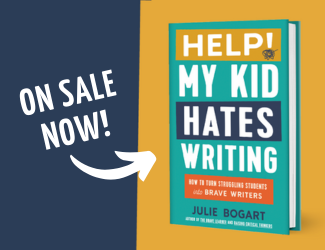
- Purchase Julie’s new book, Help! My Kid Hates Writing
- Find community at the Brave Learner Home
- Learn more about the Brave Writer Literature & Mechanics programs
- Start a free trial of CTCmath.com to try the math program that’s sure to grab and keep your child’s attention
- Subscribe to Julie’s Substack newsletters, Brave Learning with Julie Bogart and Julie Off Topic, and Melissa’s Catalog of Enthusiasms
- Sign up for our Text Message Pod Ring to get podcast updates and more!
- Send us podcast topic ideas by texting us: +1 (833) 947-3684
- Interested in advertising with us? Reach out to media@bravewriter.com
Connect with Julie
- Instagram: @juliebogartwriter
- Threads: @juliebogartwriter
- Bluesky: @bravewriter.com
- Facebook: facebook.com/bravewriter
Connect with Melissa
- Website: melissawiley.com
- Substack: melissawiley.substack.com
- Instagram: @melissawileybooks
- Bluesky: @melissawiley.bsky.social
Produced by NOVA