Brave Writer Philosophy Archives - Page 80 of 84 - A Brave Writer's Life in Brief A Brave Writer's Life in Brief
  • Start Here
    • For Families
      Multiple Ages
    • Ages 5-7
      Beginning Writers
    • Ages 8-10
      Emerging Writers
    • Ages 11-12
      Middle School Writers
    • Ages 13-14
      High School Writers
    • Ages 15-18
      College Prep Writers
  • Shop
    • Product Collections
    • Bundles
    • Writing Instruction Manuals
    • Literature & Grammar/Punctuation
    • Composition Formats
    • Literature Singles
    • Homeschool Help
    • Book Shop
    • Special Offers
  • Online Classes
    • Class Descriptions
    • Class Schedule
    • Classroom
    • How Our Classes Work
    • Our Writing Coaches
    • Classes FAQ
  • Community
    • Brave Learner Home
    • What’s Happening
    • Blog
    • Podcast
    • Calendar
  • Cart
  • My Account
    • My Online Classes
    • My Account
  • My Account
    • My Online Classes
    • My Account
  • Start Here

    If you’re new to Brave Writer, or are looking for the best products for your child or family, choose from below:

    • For Families
      Multiple Ages
    • Ages 5-7
      Beginning Writers
    • Ages 8-10
      Emerging Writers
    • Ages 11-12
      Middle School Writers
    • Ages 13-14
      High School Writers
    • Ages 15-18
      College Prep Writers
  • Shop

    If you’re already familiar with Brave Writer products, go directly to what you’re looking for:

    • Product Collections Browse the full catalog in our shop
    • Bundles Everything you need to get started
    • Writing Instruction Manuals Foundational Writing Programs
    • Literature & Grammar/Punctuation Grammar, Punctuation, Spelling & Literary Devices
    • Composition Formats Writing Assignments for Every Age
    • Literature Singles Individual Literature Handbooks
    • Homeschool Help Homeschooling Tools and Resources
    • Book Shop Books associated with Brave Writer Programs
    • Special Offers
  • Online Classes
    • Class Descriptions
    • Class Schedule
    • Classroom
    • How Our Classes Work
    • Our Writing Coaches
    • Classes FAQ
  • Community
    • Brave Learner Home
    • What’s Happening
    • Blog
    • Podcast
    • Calendar
  • Search
  • Cart

Search Bravewriter.com

  • Home
  • Blog

A Brave Writer's Life in Brief

Thoughts from my home to yours

Archive for the ‘Brave Writer Philosophy’ Category

« Older Entries
Newer Entries »

On Writing

Writing is thinking on paper.
William Zinsser

You cannot depend on your eyes when your imagination is out of focus.
Mark Twain

How do I know what I think until I see what I say?
E. M. Forster

The reason one writes isn’t the fact he wants to say something. He writes because he has something to say.
F. Scott Fitzgerald

The author must keep his mouth shut when his work starts to speak.
Friederich Nietzsche

The work never matches the dream of perfection the artist has to start with.
William Faulkner

A blank piece of paper is God’s way of telling us how hard it to be God.
Sidney Sheldon

We are a species that needs and wants to understand who we are. Sheep lice do not seem to share this longing, which is one reason why they write so little.
Anne Lamott

Posted in Advice from the pros, Copywork Quotations, General | Comments Off on On Writing

She’s Wordy and Wonderful

A Tribute to My Mom

I was twelve.
“I love your story, honey. Let’s see if we can make that opening more vivid.”

My mother gently held my first “mature” short story in her hands. My main character (who like so many protagonists bore a striking resemblance to the author—me, at age twelve) rode a train to Mexico and while on a shopping expedition, got lost.

I wrote the first draft in purple marker. Only a mother would wade through that.

And she did. My mom found all the places of imagination and affirmed them. She identified the crisis and praised it. She laughed at the right moments.

Then with quick and precise comments that made me see possibilities, rather than errors, she deftly re-opened the story by suggesting a little dialog and some “stage business” (as we say in theater). Instead of starting with the usual, “My family took a trip to Mexico” she suggested I begin with a card game between the heroine and her best friend wherein the discussion could turn to the protagonist’s upcoming trip.

Genius!

I could write that.

And what a difference it made! Suddenly the little story stood up. It felt like the novels I loved to read. I turned it in for a grade and instead received such praise from my teachers that they shared it with the whole class.

I was fifteen.
My first research paper for Honor’s English class. I wanted to be good at it. Expository writing felt like the Olympics of writing and I wanted that gold medal or to at least make the team. So I dove into my topic without help: James Thurber. I made notecards and I read his writing. I wrote a draft. I rewrote it. I edited it.

Due the next morning, I started to type what would be a fifteen-page paper at about 1:00 p.m. Those were not the days of the delete key or cutting and pasting. My first two pages were riddled with errors… and had to be re-typed.

I glanced at the clock and my stomach dropped to the floor: Daylight Savings time. I had already lost an hour…and then I lost my will and faith and any remaining typing ability. Teardrops smudged the ink on the first two pages.

“Give me your draft, sweetheart. We’ll sit together and get this done.”

I relented. She could help me. Fingers flew over the keys without error. As my mom typed, she offered editorial feedback with enthusiasm and friendliness. I didn’t mind because her advice always worked.

We got that paper done after hours at the typewriter and she never complained once. I made the team. Expository writing became my favorite writing form.

I was seventeen.
I filled out my college application on my own. My mother’s life had been turned upside down—no husband, living on her own, trying to make ends meet. I wrote the college entrance application essay and she asked to read it.

“Julie, let’s start with a hook. Sit and talk for a minute about what you imagine life after college will be like for you. I’ll take notes.”

I closed my eyes and saw an older version of me jogging on the beach with an Irish Setter at my heels. I saw myself returning to my beach pad where I poured myself a cup of tea and studied my script for the movie I would be in.

And so my essay began, “Jogging through the wet sand in my blue sweats with my Irish Setter at my heels….”

That essay caught the attention of my composition teacher. He dittoed it off and it became the model for all his seniors for how to write an essay to get into university.

I was thirty.
I had three kids who loved the library. I fell in love with children’s literature and so I wrote a children’s book: single-spaced and much too short… and sent it to my mother.

By now you know what she did: she praised it. She found many good things in that little poorly written story and then honed in on the key areas I could expand the writing and make it better. (And she mentioned I ought to double space in future).

She sent me advice for how to submit it for publication and she offered to help me write the cover letters. That week, a book on how to write children’s picture books appeared in my mailbox, sent to me from her personal library.

Once I began to study the craft, I saw how woefully I had fallen short. But my mother never told me that. She believed in me so completely, I steadily improved the piece until I received good feedback from editors.

—

My mother, Karen O’Connor, has been a writer for over thirty years. She’s published literally hundreds of magazine articles, 52 books and has taught writing for over 25 years. She knows good writing. And she writes really well.

So imagine my delighted shock when I received an email from her last week saying that she’s excited about a new writing adventure of her own: romantic comedies for seniors. And just to be sure she does it right, she signed up… for a writing class.

At 67 years old as of April 8, 2005, my mother is eager to grow, to offer her work for the same kind of critique and praise she’s so generously given over the years to earnest, new writers everywhere (me, chief among them). Always a learner, eager to make a contribution, she lives a life that sees possibilities. This focus in her outlook has literally touched thousands of people’s lives.

Because of my mom, I am not afraid to write, to express myself in writing. My mother is the original brave writer in my life. She is also a brave mother and writing coach who has modeled to me what it is to love the writer in each of us.

Thank you, Mom, for seeing the tender soul of the writer in the bad writing and helping to transform that self-expression into a satisfying product that reveals the depths of that soul. You do it so well. When I grow up, I want to be just like you.

I love you,
Julie

P.S. Happy Birthday!

Posted in Brave Writer Philosophy, General | 4 Comments »

The Last Shall Be First

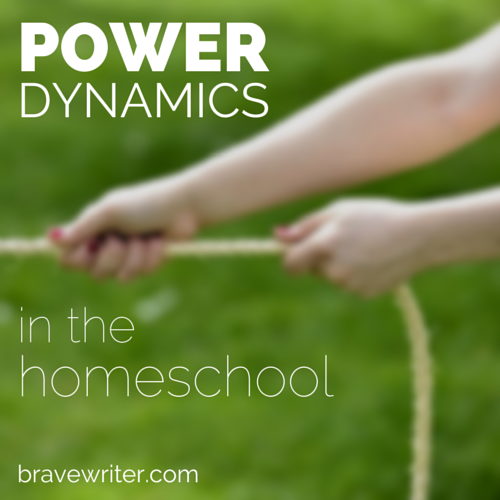
Power_dynamics

The other day and found myself thinking about the power dynamics in families. There’s no question “who’s in charge” in a family. Kids know. Parents know. Adults carry the responsibility so they have the power.

Knowing we are in charge, we often use that power to run our families and homeschools. We set out the expectations of what is to be done and then we expect respectful cooperation. When our kids don’t share the same goals and don’t have the same instincts, many parents assume the child is in rebellion or is willful. (Books have been written to illustrate this point.)

Kids who don’t share the same goals or perspective, instead, will assume their parents are mean and don’t understand kids. (Kids wish they had written books to illustrate this point.)

There is an imbalance between the perspectives of parents and children (one has books with studies to support its viewpoint and the other doesn’t; all kids have is whining, crying, ignoring and acts of passive aggression). This imbalance can create havoc for the homeschooling mom who hopes her child will write one day. Kids might believe that the mother’s insistence that they write is another one of those parental power-plays designed to meet adult needs while ignoring the viewpoints of children.

When one group experiences itself as marginalized (not able to express its views in a way that makes contact with the powers-that-be and causes change) and the other group experiences itself as in power with the ability to coerce compliance, crankiness has the chance to fester and develop into full-blown rage or disinterested passivity (the “I surrender” stance).

For some reason, working on writing causes the power struggle to show its full colors. Kids have a knack for resisting parental input when it’s related to the writing they do. Their writing is the one space that children try to protect from parental control. Writing equals “who I am” and as a result, they want their writing to be accepted as is, punctuation mistakes and spelling errors included.

If we want to see crankiness replaced by joy (since it is my contention that joy is the best teacher there is), we have to shift the power dynamics. We need to hear our marginalized poor, our “oh-so-powerless” kids. We have to “divest” ourselves of our power and serve our kids.

Here are some sure fire ways to move from first to last so your kids can move from last to first:

Apologize

I remember at one seminar encouraging the moms to rub their kids’ shoulders before a freewrite. A mom’s hand shot into the air. She couldn’t believe it! Just that morning, her son had asked her to rub his shoulders, before he started writing. She told him, “This is school. This is not play time. I’m not rubbing your shoulders. You should get to work and stop dilly-dallying.” Light bulb! She suddenly saw. Unwittingly, she had undermined his success in writing that morning.

Say you’re sorry. Then start over, together.

Take the same risks your kids take

When they write, you write. Freewrite once in awhile when they do. Risk sharing your writing so that they can hear and read it. Respect and honor the process you are asking them to engage in. You will sympathize with their efforts if you have experienced the same kinds of blocks and blanks that they experience with writing from time to time. And the biggest bonus of all: you’ll learn how you break through stuck places so you can share those insights with your kids.

Ask permission

Your child is not just a writer, but an author. Authors deserve final control over their writing. Let your child know that the input you offer is optional and that you won’t give unwanted input. Discuss artistic choices. Then let the writer decide which of these artistic choices she prefers to make. If you take this approach with all writing (personal, academic, assigned), over time your child will come to value and ask for your input. Trust me.

Ask for your child’s writing goals

Your child may tell you up front that he has no goals for writing. If that is the case, you can share the goals you have for your writing… and then pursue them, right in front of your child. “Wait honey. I’m working on that piece about gardening for my online community, remember? I’ll be right with you. Hey can you listen a minute, how does this sound?”

I know you have goals for your children’s writing. We’ll discuss that at another time. Right now we are working toward unhooking the power struggle.

If your child has goals (such as, wanting to start a live journal or wants to write a short story or is interested in learning how to write poetry in calligraphy), talk about ways that you can support your child in reaching those goals. Does she need more time on the computer? Does he need a book about story writing? Can you purchase a set of pens and offer a book of poems with which to practice her calligraphy?

Make writing opportunities interesting

If writing has become a curse instead of a joy, take a break from writing. Read, talk, read, talk, watch movies, read, talk.

Then pick a surprising writing activity. A new freewriting prompt left on an empty kitchen table with brand new colored pens and pretty paper sometimes jump starts the process as well. Don’t say anything. Just leave it all out and see what happens.

Jump in the car and bring journals along. Write at a coffee shop, all of you, together.

Change the setting and you’ll change the attitude.

If you shift the power dynamic in your home, giving up some of your power so that those without power get some, you’ll see a shift in the level of joy in your home. It may take some time before they trust that you are truly divesting (not just manipulating them). You have to let go of outcomes and not see this as a strategy. But once they believe you, that you are unequivocally on their side and they know it, they will trust you to give input into their writing and to even make some suggestions of what kinds of writing they may want to attempt or learn.

It’s really true, the last shall be first.

What an honor to be the one to foster that kind of home environment.

Image © Softdreams | Dreamstime.com

Posted in Brave Writer Philosophy | Comments Off on The Last Shall Be First

My Communication Game

“I heard about Brave Writer and wondered what The Writer’s Jungle is.”

“The Writer’s Jungle is a manual that teaches moms how to teach writing.”

“Yes, obviously, but how does it compare to Writing Strands or IEW?”

“Well, it teaches you, the mom, how to teach writing.”

“Okay, okay. I get it. But what does it teach that is different from IEW for example?”

“Let me try that again. The Writer’s Jungle teaches the mom how to teach her kids to write. See, it shows her how to teach writing. Like, it actually gives you instructions for how to teach writing.”

Flapping my arms wasn’t helping.

Then the other day at our homeschool co-op, another mom asked me the dreaded question: “So what is The Writer’s Jungle and how does it compare with….?”

I stuffed some chips into my mouth to buy time.

Good thing I did. A friend (and recent convert to Brave Writing) spoke up. She has a delightful German accent and so her comment will always have that ring to it when I think of it again.

“Oh dat’s easy. The od-ther programmes tell you v-what to do. They don’t show you how to do it.”

Thank you! That’s it exactly.

It isn’t enough to be told to write a paragraph or a letter with a set of guidelines. We have to start with how to get words, how to move pencils, how to think. First we help our kids learn how to write. Later we can show them what to write. Or by then, they might show us!

Posted in Brave Writer Philosophy, General | Comments Off on My Communication Game

Start in the middle

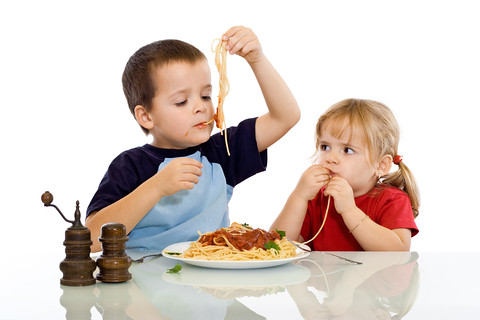
Pasta
Writing Advice

Want to spruce up an opening? Start in the middle!

Sure you could write:

I love spaghetti. It’s my favorite dinner.

But seriously, who cares that you love spaghetti? We’re finished before we start. The truth is out and there’s nothing more to know.

So how about starting in the middle?

The noodle slipped out of my mouth and smacked my sister’s chin.

Whoa! How did a noodle get from your mouth to his chin? We all want to know! And so we’ll keep reading…

Another example:

Dogs are better than cats.

Yes, this qualifies as the typical topic sentence. However, it doesn’t conjure up anything in my imagination. Readers are fickle. They want to be lured forward as though on a treasure hunt for the next clue to what the writing is all about. If you let the “cat out of the bag” too soon, the reader is bored and will only slog through the writing if required to give it a grade.

How about:

I try not to take it personally when Cookie, my cat, goes on licking her paws when I get home. Charlie, my dog, on the other hand…

Starting in the middle might not seem like you are following the topic sentence top down paragraph form. But it’s one of the most common tips in revising that professionals are taught.

Tell the story and I’ll know the topic!

Image © Nagy-bagoly Ilona | Dreamstime.com

Posted in Brave Writer Philosophy, Writing about Writing | 2 Comments »

« Older Entries
Newer Entries »
  • Search the Blog

  • Julie Bogart
  • Welcome, I’m Julie Bogart.

    I’m a homeschooling alum -17 years, five kids. Now I run Brave Writer, the online writing and language arts program for families. More >>

    IMPORTANT: Please read our Privacy Policy.

  • New to Brave Writer? START HERE

  • FREE Resources

    • 7-Day Writing Blitz
    • Brave Writer Lifestyle Program
    • Brave Writer Sampler: Free Sample Products
    • Freewriting Prompts
    • Podcasts
  • Popular Posts

    • You have time
    • How writing is like sewing
    • Best curriculum for a 6 year old
    • Today's little unspoken homeschool secret
    • Do you like to homeschool?
    • Don't trust the schedule
    • You want to do a good job parenting?
    • If you've got a passel of kids
    • You are not a teacher
    • Natural Stages of Growth in Writing podcasts
  • Blog Topics

    • Brave Learner Home
    • Brave Writer Lifestyle
    • Classes
    • Contests/Giveaways
    • Friday Freewrite
    • High School
    • Homeschool Advice
    • Julie's Life
    • Language Arts
    • Movie Wednesday
    • Natural Stages of Growth
    • One Thing Principle
    • Our Team
    • Parenting
    • Philosophy of Education
    • Podcasts
    • Poetry Teatime
    • Products
    • Reviews
    • Speaking Schedule
    • Students
    • Writing about Writing
    • Young Writers
  • Archives

  • Brave Writer is a participant in the Amazon Services LLC Associates Program, an affiliate advertising program designed to provide a means for sites to earn advertising fees (at no extra cost to you) by advertising and linking to amazon.com

    Content © Brave Writer unless otherwise stated.

What is Brave Writer?

  • Welcome to Brave Writer
  • Why Brave Writer Works
  • About Julie
  • Brave Writer Values
  • Frequently Asked Questions
  • Speaking Schedule

Brave Writer Program

  • Getting Started!
  • Stages of Growth in Writing
  • The Brave Writer Program
  • For Families and Students
  • Online Classes
  • Brave Writer Lifestyle

…and More!

  • Blog
  • Classroom
  • Store
  • Books in Brave Writer Programs
  • Contact Us
  • Customer Service
  • Brave Writer Staff
© 2026 Brave Writer
Privacy Policy
Children's Privacy Policy
Help Center