Archive for the ‘Young Writers’ Category

Late Readers

Thursday, March 19th, 2009

I shared a bit about my family and their reading habits. Let’s look at what you can do with late readers in yours.

First of all, don’t fall for the idea that if your kids were in school, they’d be reading. Plenty of kids fall through the cracks in school too, and many are put in the wretched position of having to be identified as poor readers by virtue of being gathered together into a late reader’s group! Not only that, the primary function of school is to get a group of kids to assimilate skills and information at about the same pace. That means falling behind is a problem to be solved. It means that your child is a problem to be solved. At home, there is no “falling behind.” Your child is not a problem.The only goal is to move at a pace that supports and affirms your child’s progress.
(more…)

Reading and Writing – a match made in linguistic heaven

Thursday, March 5th, 2009

Seems like I’ve had a spate (what a great word!) of email asking about reading and writing, and the connection between these subject areas. So let’s tackle it.

Reading is the single most important part of your homeschool. It matters not if your children read or you read to them. What matters more than anything is that they are repeatedly immersed in written language. (I’ll talk about learning to read in a moment.) Written language has its own cadence. It differs from conversation. Conversational language is stacatto, is inflected by facial movements and vocal intonations, is accompanied by body language and is contextual (often replying to words, ideas known to both speakers).

Written langauge is blind and deaf. It can’t see your face, can’t hear your reactions. It takes nothing for granted. The whole world it seeks to share must be conjured by magic – the magic of words. Reading to your kids, ensuring that they read every day, does more to shape how they will write than any workbook, writing course, or curricula. I will repeat that because no one believes it on the first pass. Reading every day is the best writing program you can “buy.”
(more…)

Forums: How it works

Monday, December 15th, 2008

The following is posted on the Brave Writer public forums. I loved it! Such a great example of how it’s supposed to work. :)

Today, I wanted my nine year old to really get into telling a story so rather than bog him down with the handwriting, I figured I would type for him while he dictated his story.

At the breakfast table this morning, we developed a character. I started off by saying the character was a boy. Then he added a detail about the character, then I did, and so on until we had quite a description going of this kid who lives in a jungle and has a pet monkey.

Then this afternoon, I grabbed my laptop and we hit the couch and curled up with blankets and pillows for him to “write” his story. I started him off with the typical “One day…” and he took it from there.

It was a bit of a struggle to begin with but then he was cruising and had so many thoughts flying out of his mouth. After I had typed a whole page, he said he was out of ideas but the story was at a cliffhanger moment actually so I told him that was enough and we could call it Chapter One.

He was so excited by the whole process. He has been running around all afternoon with his story that we printed off. He even decided to start a new club with his 6 year old sister called “The Story Club.” He asked if he could use my laptop and they both sat at the kitchen table while he guided her through the process of developing her own character. He typed while she dictated. Now, he can’t really type so this was a long laborious process but he was not deterred. My daughter lost interest before he did which I was surprised at as he had to do the typing. So he saved her character and I have a feeling they will come back to it another day.

I’m looking forward to him continuing his story and having fun with his imagination and words!

Writing your revision feedback

Thursday, December 11th, 2008

One of the ways we help moms in our primary writing course, Kidswrite Basic, is to give them an understanding of how to affirm the good and enhance the weak in their children’s writing. Because the classes are in an online format, all of our communication with parents is through writing. We read the work done by your children and then we comment on it by posting our thoughts almost line by line.

A parent can then print the post and have a concrete record of the steps to take to improve the writing with the child. The written revision notes, in turn, provide a model for future interactions with your child when you are on your own.

Part of what makes the class feedback so powerful for both you and your child is that it is thorough. It goes through the draft systematically, asking questions of the text, noting clever uses of language or insightful ideas, identifying the places where a few more thoughts, words or sentences would expand the meaningfulness of the content, noting which part of the piece might serve as an opening hook, and so on. A parent can read this feedback and take it, evaluate it, then make use of it with her child. But she can also print it and hand it to the child to be read together as a way to discuss editorial feedback. In this case, the pair has triangled in a third party and it is easier to evaluate the comments together, sitting on the same side of the fence than when it is mother directly to child.

Still, once class is over, some moms revert to the habit of quick, verbal feedback that is offered right as the draft is finished, with little time to pause and enjoy the original act of creation. Other moms, though, have discovered that they can approximate the experience of that nurturing environment by emulating that process!

One way to do this is to always type the draft/freewrite into a Word doc. Then, later in the day when you are alone away from your child, give it the kind of attention a KWB instructor might. Go line by line looking for those places you can offer affirmation and positive feedback. Type that in, including smilie faces and exclamation points! As you find places that show insufficient development, ask for more. You can write, “I love this. I’d love to hear more about it. What else happened that day?” When you stumble across an alliterative word pair, highlight it saying, “Great repeated use of the “h” sound here!”

As you write the feedback, you’ll become calmer and you’ll also discover that your eye when you read naturally gravitates to error rather than strength. But giving your child’s paper enough respect to write your feedback, you’ll slow down and become more aware at the successes within it—the makings of a good paper.

When you have typed up your comments right in between all the original writing (using a different color or italics or bold), print it out. Get some tea, cookies and a pencil. Then sit with your child over the yummy treats and read it together. Talk about the feedback you give and allow your child to offer you his or her perspective on what you wrote. This kind of discussion enables you to use the paper as the triangling force so that you and your child remain on the “same side” of the discussion.

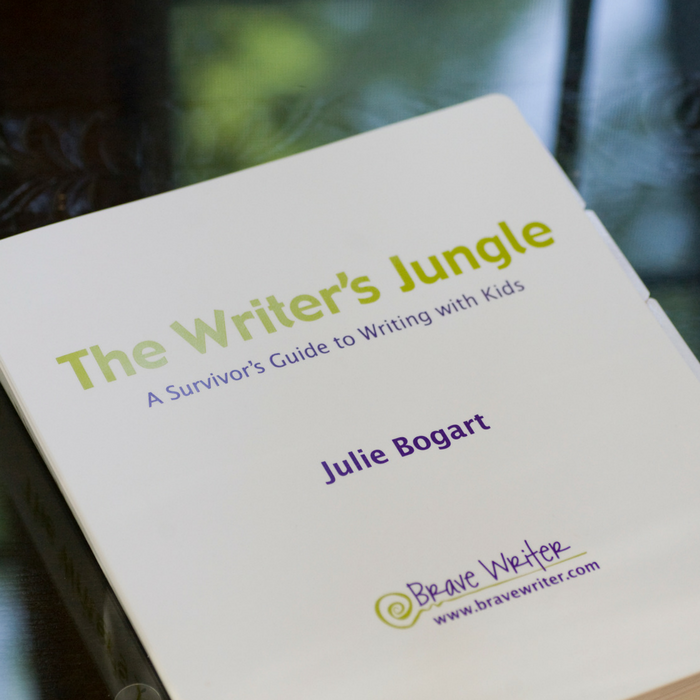
For those who really want to see this process in action, I strongly urge you to take Kidswrite Basic in the winter quarter. It is repeatedly the key step in the process to becoming an excellent writing coach and ally for your kids. When I’m asked whether it is better to purchase The Writer’s Jungle (an excellent resource for the self-directed, to be sure) or to take Kidswrite Basic, if you have to choose between them, I always recommend the class. It is the best way for you to become fluent in the skills of coaching writing.

Reluctant Revisers

Wednesday, December 10th, 2008

Julie-
I am posting here in response to the “Brave Revising” email, you sent out.

I am wondering about reluctant revisers. My 12 year old daughter will free write beautifully and willingly , but resists my input on revising. I feel like I am judging her work when I do offer suggestions.

I am considering taking the revising course, but would love to hear what you have to say about gently and effectively revising.
Thanks.
Anne

Great question Anne!

Revising, for most kids, feels like criticism. They take it personally when errors are found in their writing. Yet find them we do and we can’t very well ignore glaring mistakes in punctuation or grammar, don’t want to overlook the opportunity to encourage more details or facts.

So let’s start with the philosophy of revision so that you can rethink how you might go about fostering a safe space for it. Revision is not the same as mopping up the mechanics. Editing is the final step in a paper and that’s when your eyes get to be really picky about what they see. That final step means going over the typing (or handwriting) with a fine-toothed comb, looking for errors to clean up right at the last minute. The content will stay as it is.

Revision, on the other hand, is about reshaping the original piece. Its focus is the content and how to narrow vague ideas, how to expand poorly developed ones, how to reorganize the piece to flow with more power and so on.

Most of the time, the mistake we parents make is that we move from draft to editing in one step. Or we might move to revising and editing at the same time. When a child risks writing and shares content with you, if the first thing you notice is the misspelled word, the child literally feels insulted and hurt (like you missed the point!). Let me give you an example of how it feels:

What if you had dolled yourself up for an evening out with your husband: new hair style, brand new shoes, glittery sexy top, slinky pants… and when you appeared in the room, he said, “Aren’t you going to wear the earrings I bought you?” or worse, “You’ve got lipstick on your teeth.” Rather than being bowled over by the original impact of your overall look, he notices first thing what you didn’t wear or he points out the one mistake in the look (something that could easily be corrected moments later after he tells you how much he’s dying to throw you down on the bed and make-out with you).

If he had simply expressed his amazement at how great you looked first, you’d probably be more than happy to consider adding his earrings to the ensemble. And of course you’d want to know about the lipstick on your teeth before you left the house. It’s just, those are not the first things you want noticed after all that work to surprise and amaze your husband.

With writing, your kids are risking their precious insights, words, knowledge, ideas every time they commit them to paper. Your first task, then, is to notice! Find the quirky idea, vocabulary word or fresh insight and praise it! Be impressed by the amount of writing (no matter how much is there). Engage the material with follow-up questions that show you are interested in more of their ideas (not to elicit “better” material, but to show that you really do care about the topic and are impressed with what they know about it).

Once you’ve done that, on another day you can tackle the revision needs. Here are a couple of principles to keep in mind when you go to help with revision.

1. The writer is the author and therefore has final editorial control. That means you are offering ideas and suggestions, not giving commands or edicts.

2. Your suggestions for improvement are better framed as options to consider. When you read along, it works better to say, “I loved this part that details the preparation of the meal. I’m wondering about the colors of the foods in this particular recipe. What are they? Do you think that might add a little more detail to the original?” Invite dialog around your suggestions and ask their opinions. You can offer to jot little notes in the margin so they don’t forget what you discussed together.

3. Ask your child for his or her ideas for revision. Sometimes we assume that they have none, that they are satisfied with the writing as is. Truth is, if they get a few days away from the draft, they may find that when they come back to the draft, they have fresh energy and eyes and are interested in expanding it or enhancing it with more detail.

4. Which brings me to my most important point: Separate revision from drafting. Never do them on the same day. Spend time enjoying and praising the draft on one day. Then let a couple days go by before revisiting the piece with revision ideas.

5. Save all editing (mechanics, punctuation, grammar, spelling, typos) for the end, once all revising is done. Resist the temptation to correct as you go. Unless your child spontaneously corrects them upon review, you are to keep your hands in your pockets. :) Editing is the final step that is done after you are thoroughly finished with revising.

6. Remember: not every has to be addressed in this paper. Expand, enhance, correct, improve one or two things and leave the rest. The problems in this paper will magically reappear in future writing to be addressed then. We homeschool parents tend to expect perfection every time. Totally unnecessary in writing development. Allow for the growth in writing to be a journey through multiple pieces of writing, not just this one.

When freewriting isn’t fun

Tuesday, December 9th, 2008

Not everyone likes freewriting. Some kids feel pressured by the timer, they worry about making mistakes (even after being told that they can make all the mistakes they want!), they resist the idea of writing about any random topic. Others just don’t like writing and freewriting feels like one more writing task no matter how many times they are told that this is an easier form of writing than the one they are used to.

Our oldest son (Noah, 21) told me that while he can write (and I’d say he writes well!), and while he certainly does know how to freewrite (and has done plenty of it), writing has never gotten easier for him. When he faces a blank page, he still fights the sensation of momentary panic and inertia.

And yet, I still firmly believe that every person can learn to write so that they are competent as adult writers. Even if they have that initial surge of panic when staring at a blank page, they will have cultivated some strategies for tackling the topic anyway! That’s what I’d like to talk about in this blog entry. Tomorrow, we’ll look at revision and how to make some sense of the chaos freewriting unleashes.

Freewriting gives writers a chance to get the swirl of words inside, out of their heads and bodies and onto a page or computer screen. Those words, once out and visible, can be honed, revised, enhanced and massaged into better prose or exposition. Freewriting helps to untangle the jumble or to at least put the writer in touch with what there is to say (or not) about a topic.

Part of the charm of freewriting (its lack of structure, its freedom, its open-endedness) sometimes causes a surprising counter-reaction in some kids. These young writers feel too much freedom! They want guidelines, structure, clarity about the expectations. They want to avoid making a mess that will be required to go through a revision process later. So let’s look at how to help them over the hump with some novel ways to make freewriting less “free” while retaining the essential messiness that is most beneficial in terms of real writing later.

Topics
Some kids really do need a subject to get them going. Asking them to simply “write” whatever is on their mind is too big. Their minds are busy places and they can’t narrow the swirl of ideas down into a manageable size for writing. To help these kids, we suggest the “freewrite list.” One week, instead of freewriting, ask your kids to write a list of all the things they love and know lots about. This list can be written straight down the page and can include things like: soccer, horses, Harry Potter, how to make cookies, quilting, pet ferrets, hacky sacks, Starcraft, decorating Christmas trees, blow drying hair, WWII tanks, Star Wars, American Girl doll outfits and planting bulbs. There are no right topics. Only those your kids love and know well. Once you have a list, each week let your child pick a topic from the list to write about.

Too much time
Some kids do better with a few more boundaries around the freewrite. Rather than a 7-10 minute period, limit the time frame to 2-3 minutes. Ask your child to write as quickly as possible, without stopping, putting anything that comes to mind onto the paper. Keep the sessions short and don’t worry at all about content. The idea here is to just keep the pencil moving for 2-3 minutes.

Perfectionism
Some kids are haunted by a need to know how to spell, how to punctuate, when to capitalize and so on. To be told that errors are permissible doesn’t ease the anxiety. Usually there are two reasons for this. The first is that the child is just one of those neat-nik kids who prefers order and hates a mess. For that child, simply tell him that if he doesn’t know how to spell a word, to call it out to you and you will instantly recite the proper spelling so he can continue without stopping. If this happens every third word, then you will need to let him know that he can make his mistakes but you promise to correct them with him as soon as he finishes.

The other kind of perfectionist is the one who knows that any mistake she makes will be required to be fixed by you. These kids are the ones who’ve figured out that if they don’t write perfectly the first time, they’ll have to revise and edit until you are satisfied with the product. First, reassure your child that this freewrite will not go through any revision. When it’s done, it’s done. Second, take a piece of scratch paper, crumple it up and then smooth it out again. Tell your child to freewrite on the crumpled page. Often, just seeing that the paper cannot possibly be used as a final copy will prevent the tendency to be overly careful with the freewrite.

Hurting hands
Some kids grip their pencils so tightly that when you add the pressure of a timer (and the instruction to write speedily), they cause themselves pain when they freewrite. No wonder they hate it! For these kids, you can try two options. For younger kids whose handwriting skills are still developing, offer to type their freewrites while they narrate orally to you. For older kids, let them freewrite on the computer from time to time until they learn to relax their hands.

Natural writing resistance
Some kids are naturally less verbal than others. They fight to find the words they need in their oral communication and find writing that much more of a challenge. Freewriting is an invitation to pain, for these kids! It’s like they have to openly admit that words don’t come easily to them. It’s not that they can’t speak, but they find themselves moving at a slower verbal pace than the chatty-Cathy’s around them. For kids like this, sometimes a timer feels like pressure rather than release. I suggest instead of timing these kids, ask them to write until they are exhausted. That may mean they write one sentence and that’s all they can muster. Encourage these kids especially to write about that frustration as it comes up. They can write things like:

    I love playing lacrosse with the junior high team but i hate it when I don’t get to play attack. I’m so mad that I have to write. This is hard. My hand is cramping. I want to play attack.

Like that. They need to be helped to really express what is in the way of the words. These kids tend not to give language to their frustration or their physical sensations. So you can draw them out with questions, etc.

For those kids who are truly struggling, we strongly recommend our One Thing: Freewriting class. It’s the sequel to our very popular One Thing: Copywork/Dictation class and taught by Rita Cevasco, our specialist in reading and language disorders.

In this class, kids will be helped to approach freewriting through a variety of novel tactics that will give you brand new ways to introduce the practice while accommodating the struggle. Please post specific questions in the comments below and I’ll try to tackle them for you today.

The distance between voice and mechanics

Thursday, October 30th, 2008

Seems like this week, I’ve had a lot of email and a couple of phone calls expressing anxiety about writing. Nothing unusual about that in my in-box. But the concerns overlapped in the type of anxiety they expressed. Moms new to Brave Writer find it really hard to believe that it is possible to nurture your child’s writing voice without worrying about the mechanics of writing. They wonder if they are fostering a carelessness in their children’s writing habits. Shouldn’t they learn to care about how they spell, how they punctuate, how they construct their sentences and paragraphs? Isn’t attentiveness to the form as important as attentiveness to the content?

It’s true that meticulous care about mechanics is a final step in every writing process. When students in high school turn in papers to me, I always tell them that they can make sure it is error free. They have spell-check, parents, friends – all who can lend support to finding spelling errors, missed punctuation and typos. The presentation of the final paper is a psychologically important part of grading a paper, in fact. A teacher, parent or professor is put at ease when the writing is without error. The mechanical perfection of the paper renders the form invisible and frees the reader to focus exclusively on content. What a joy that is!

So yes, mechanics matter a lot in writing and there’s nothing at all wrong with expecting a high standard in the final product. Far be it from me to ever have associated with my name a carelessness about how the final paper is presented!

On the other hand, there is a peculiar challenge in writing. To find one’s meaning, to explore and excavate one’s ideas requires a letting go of the wheel. It’s hard to focus on the end marks and spellings when you’re inner eye is trained on an idea and where it is going. For your kids, who are even less skilled as writers, it’s even harder for them to pat their stomachs and rub their heads simultaneously. They haven’t got years of writing and reading under their belts. The conventions of punctuation aren’t automatic for them. To write “correctly” requires effort and attentiveness. If they focus on how to put it on paper, they lose touch with what they want to say.

The quickest way to kill a writer’s inspiration is to ask him or her to think about how to write before the writer has thought about what to write. Start with the ideas, images, thoughts, fantasies. Later, once all that mess is out there, it’s possible to shift gears and give full attention to editing. In fact, it’s surprisingly satisfying to clean up the mess of creativity once it is on paper. Editing is relaxing in the way that mowing the lawn or ironing a wrinkled shirt is. You see progress instantly!

So save mechanics and instruction in how to execute them for copywork, dictation and other people’s writing. In the meantime, while you are growing a young writer, give full attention to what that writer wants to say and how he or she wants to say it. Mess with meanings, play with words, wriggle around in disorder and creativity. Then, once the words are all over the page in their glorious chaotic sense, impose a little order by editing for spelling, punctuation and grammar.

That’s the best (and I daresay, only) way to cultivate writing voice while giving some attention to the mechanics of writing.

First Freewrite: new to Brave Writer

Tuesday, October 14th, 2008

Hello Julie,

I stumbled upon Brave Writer only a few weeks ago, loved what I read on your site, got BRAVE and veered off my writing plans for this year to follow a brave writer lifestyle. I have not looked back, nor regretted this decision. Brave Writer has brought fresh air into this house! I’m still reading through your book and we are slowly incorporating its ideas into our days.

I’ve included my 9 yo first freewrite and a picture of my 7 yo about our trip to a raptor conservatory. We didn’t polish this piece, as it was the first one ever, but I thought it turned out really well (9 yo went well past the timer :-) . Good sign for a “first time”).

Sincerely,
Verena

Hi. I’m Robert Raptor I’m a Bald eagle. I’m going to tell you a story well it happend this way, one day I was out hunting my wife was having babys, anyway I was perched on a tree when I saw my Friend Golden eagle.
I caught up with him and I said: “Why dont we hunt together”. So we flew together for a while,
when I saw a flock of Piagons, yumy yum. So we dived thourgh the air I could feel the good wind
through my feathers, on the first try Goldeneagle caught one and flew of to his nest but I didn’t get
one so I climbed higher and dove again this time I got one and flew
off to my nest when I got here, I had a surprise! Four newborn chicks!

bald eagle

Email: Scavenger hunt (!) and original poetry

Thursday, September 11th, 2008

Let me alert you to two great things about this email.

1) How awesome is it to have your kids bring original poetry to the teatimes? I get emails sharing this same story again and again. You just never know what will catalyze the poet in your child! Remember: the right answer is, “Yes! Bring it. Can’t wait to hear it.”

2) A scavenger hunt for your school work? WOW! Wish I’d have thought of it.

I’m finally kicking our Poetry and Tea Time back into gear for the year.  I asked each kid to find two poems they liked to bring to read at Tea Time.  Nathan asked if he might bring two original compositions in addition to selecting two.  Um, yeah, you can do that.  Wait, twist my arm. Ok, uncle.  Go ahead.  Write original poetry.

Here is his AUTUMN acrostic:
Azure skys, brown leaves.
Under the trees, the black bear leaves.  Under the meadow,
The black bear sleeps.
Under the leaves, the jay stops his song.
Moving day has come along.
Naught but bare trees now are left, as frost steals up to make a theft.

Yesterday, as an aside in his Scavenger School (I hide their assignments all over the house, so they end up doing math in the bathtub and such), I asked him to write a poem.  Here it is, an acrostic (I guess he likes those) on SEASONS:

Snowy winter
Excellent spring
April rains
Summer sunny days
Oops, time to dig out long sleeve shirts and pants
Nothing but a beautiful fall
Snowy winter again.

Blessings,
Holly

Check out Holly’s blog!

Back to school party

Wednesday, August 27th, 2008

I had fun parents. They liked parties and didn’t care if you had a birthday attached to them or not. One year, my dad and mom helped me plan and execute a big Valentine’s party whose theme was sports (totally their idea). My maiden name is Sweeney and we called it: “The Sweeney Sports Spectacular.” Each room in our large house had a different sports event (putting golf, Nerf basketball, horseshoes, tossing cards into a hat, ping pong, calisthenics and so on). We paired up into boy-girl teams (7th grade – which meant it was a bit agonizing and thrilling!) by drawing name cards that created new words. So a boy might draw “hockey” and the girl would draw “puck” and that made them a team.

Scoring rules were posted at each sports’ site and we were given score cards to keep track of points. There were pretty silly trophies for highest scores, lowest scores, silliest team, etc. Loads of fun and it had nothing to do with celebrating me. Just a great way to be with my friends. So that’s a glimpse into my parents. They were fun!

My mom (who had been a school teacher before I was born) had a special affection for all things academic. When I was in fifth grade, she helped me organize a “Back-to-school Brunch” (all this alliteration!). We invited ten of my girlfriends this time for a morning of omlettes, pastries and games. Party favors included new pencils with psychedelic designs on them, groovy 1970s stickers, pink erasers, and Pee-Chee folders. We played games like “unscramble the school words” where each girl had a sheet of paper with typical words related to school all mixed up. We raced to see who could unscramble them the fastest. We covered a text book using paper bags, scissors and tape (in a race). There were other games I don’t remember. But the idea was to make the return to school something to celebrate, rather than dread. And it really worked!

As I spend this week getting ready for next week (when we start), I thought about homeschooling and its varities of traditions: the brown boxes from UPS that bring new, unused books to the family that get ripped open with enthusiasm; the ease of finding pencils because at the start of the year, there are lots of them and all in one place; the joy of starting a new read aloud and snuggling together again on the couch; the resumption of teatime and poetry that draws the family together once per week…

In Brave Writer, we try to see things through our children’s eyes. Sometimes our own weariness sets in and we forget that children still need surprises, specialness, treats, awe, wonder – in large doses! So think about how to get off on the right foot this fall. What can you do to make this a season that draws your children’s good will to the surface and creates a memory as vivid as the “back-to-school brunch” is for me.