
Archive for the ‘Poetry’ Category

Why Poetry?

Wednesday, September 30th, 2009

It’s been awhile since I’ve made my case for poetry. So let’s do that today!

Why poetry?

Lots of moms are intimidated by poetry, imagining that poets hide mysteries within their rhymes. They feel inadequate to plumb those depths sufficiently for insight and meaning, thinking their kids will not “get it” either. High school poetry units often left many of us scratching our heads rather than savoring language.

In the homeschool, you get to reclaim poetry as a legitimate tool of language arts. Poetry is all about the words: choices, sounds, relationships, punch. Poetry aims to get a message/story across within limits: meter, rhyme, alliteration or assonance (or both!), stanzas, numbers of words. It’s the Sudoku of language!

Here are the ways I recommend you dip your toes into the stream of poetic expression:

  1. Read it. Don’t worry about meanings, themes, alliteration, rhyme schemes or meter. Simply let the words roll around in your mouth. Read the poem and ignore the temptation to wonder at it. Let yourself feel the words. You might only react positively to a word pair or one ending rhyme. That’s perfectly fine! In poems that don’t offer up their meanings easily, start with reading and letting yourself connect to whatever it is that draws your attention. (If nothing does, it’s fine to move on to the next poem. No need to squeeze “blood from a turnip.” You might “get it” some other year.) Also, read it through multiple times before you render a judgment. Poems benefit from multiple readings.
  2. Listen to it. As you read it aloud (or as the poem is read to you), listen to the sounds. Ignore meanings completely. What stands out? Rhyme? Repeated vowel sounds (assonance)? Repeated initial consonant sounds (alliteration)? Repeated consonant sounds throughout the line or poem (consonance)? How about interesting word uses (a noun acting as a verb, or a made-up word like you’ll find in Carroll or cummings)? Is there a rhythm you can anticipate? Can you beat your hand to the sounds – the accented syllables versus the ones that don’t make you slap your leg? Is there a pattern (each line starts with “I wish…” or ends with “…and so it goes”)?
  3. Listen to it for word choices. In addition to noting the sounds, note the word choices. Are there surprises (words used in ways you wouldn’t ordinarily think of them)? Are they plain Jane words (nothing special except they all go together in an interesting way)? Do you find yourself thinking about the way a word is used? Does the poet focus on concrete experiences or metaphor or something else? Is it funny? Why? Puns? Irony? Punchline humor?
  4. Meaning or theme? Now we get down to the point of writing the poem. What’s it about? You can be as superficial as you want. Just get the gist. Consult your kids if you feel stuck. They are surprisingly insightful. Figure out if the poem paints a picture of an emotion or experience, or if it is detailing a story or telling an idea. Perhaps it is commenting on a theme such as patriotism or friendship or love or autumn.
  5. Do you like it? Guess what? No right answers here. If you find it inscrutable, hard to read aloud, beyond your reach intellectually, of course you won’t like it and you don’t have to. It may be that you aren’t the right audience or it could be that you haven’t yet cultivated your poetic “sensibility” enough to get this more sophisticated poem. Remember: there are just some arenas where depth supports understanding (algebra and calculus are two of them; poetry is another). So if it so happens that you can’t appreciate some famous poem all your teachers told you was the best in its genre in 1762, that’s okay! You’re not there yet and you don’t need to be.

When you read poetry with kids, choose books that are high on rhyme, humor and concrete experiences. You’ll know they like it if they want to keep reading more from the same book. If they don’t, pack it up. Send it back to the library and go to the next book. The goal here is enjoyment of language. So many good (subconscious) things are going on in your head and in your kids’ heads when they play with poetry. Serve tea, cookies and a big side of optimism and your poetry experiences will become the highlight of your week. Trust me. I’ve seen it happen thousands of times.

Share favorite poetry books in the comments or ask me questions (or tell your story!). I’d love to hear from you.

Taking time for you

Wednesday, June 24th, 2009

I know it’s tough to carve out time for you when you’ve got children who need lunch, rides, help and sleep. I have a few tricks up my sleeve for how to recharge even with kidlets at your feet. Let’s break these down into time allotments. So, for instance, if all you’ve got is 30 seconds, you can still take time for you.

30 Second Time Out

  • Splash water on your face
  • Steep a cup of tea
  • Look out a window and SEE a bird (name it if you can)
  • Put on lipstick
  • Look in the mirror and smile at yourself
  • Get a child to massage your shoulders
  • Stretch your body (arms over head, up on tip toes; or, sideways bends in each direction, feet apart)

5 Minute Time Out

  • Drink that cup of tea in one chair (don’t move – sit all the way through it)
  • Clear one annoying surface (couch, coffee table, kitchen counter)
  • Page through a new magazine (just page – you don’t have to read it)
  • Send a text to a friend
  • Put on make-up (quick version – mascara, blush, lip gloss) and earrings
  • Prop up your feet and lean head back; close your eyes
  • Take a brisk walk around your house (outside if possible)

15 Minute Break

  • Turn on music you pick (iPod, radio, speakers for your iPod)
  • Read poetry (get that book out and sit with a couple of poems)
  • Close your eyes and lie on the couch (eye pillow is really great if you have one)
  • Email someone
  • Walk down the block (alone if possible, or with baby in sling or backpack – keep house in sight)
  • Read one chapter of the book you want to read
  • Make your bed and straighten your bedroom

30 Minute Break

  • Combine some of the ideas above: tea with poetry and music, for instance
  • Take a run, do yoga, stretch, go for a bike ride, take a long walk
  • Focus on a project (for instance, put in 30 minutes toward playing piano or working on an art collage or planning a new kitchen)
  • Study something YOU want to study (design, art history, growing herbs, theology, nutrition, quilting)
  • Call a girlfriend
  • Take a nap (set the timer)
  • Take a shower

3 Hour Break

  • Get out of the house (that means, this break is planned so childcare is handled)
  • Go to a coffee shop, library or a natural setting like a park (rejuvenate)
  • See a movie with a girlfriend (or alone)
  • Eat out (choose some place tasty)
  • Visit an art museum without your kids
  • Go to a botanical garden
  • See a play
  • Write (if you write); Paint (if you paint); Craft (if you craft); Play music (if you play something)

If you can contrive a longer break, by all means take half a day or a full day. I used to take Monday nights (three hours) to go to the library. My husband would look after the kids (they were little!) and I’d reserve one of the library’s private conference rooms. I’d go in the room and either write (I was working on a book), write songs (I was learning guitar at the time and loved writing lyrics), pray (some weeks were like that) or cry (other weeks were like that). It was my time to use as I wished. I liked the library because no one could get to me, it was blissfully quiet and I would not be interrupted by anyone or anything.

Even tiny breaks are good. Put a flower in a vase, light a candle, eat one square of chocolate that you’ve hidden in your cupboard, straighten the photos on your refrigerator, brush your hair (feel the bristles on your scalp), make yourself smile, notice a reflection and see it… Be in the moment for a moment today. It helps.

Happy Birthday William!

Thursday, April 23rd, 2009

Shakespeare that is.

Fun Shakespeare facts:

  • Nobody knows Shakespeare’s true birthday. The closest we can come is the date of his baptism on April the 26th, 1564. By tradition and guesswork, William is assumed to have been born three days earlier on April the 23rd, a date now commonly used to celebrate the famous Bard’s birthday.
  • Shakespeare, one of literature’s greatest figures, never attended university. (Unschoolers take courage!)
  • The Bard is believed to have started writing the first of his 154 sonnets in 1593 at age 29.
  • William never published any of his plays. We read his plays today only because his fellow actors John Hemminges and Henry Condell, posthumously recorded his work as a dedication to their fellow actor in 1623, publishing 36 of William’s plays. This collection known as The First Folio is the source from which all published Shakespeare books are derived and is an important proof that he authored his plays.
  • As an actor performing his own plays, William performed before Queen Elizabeth I and later before James I who was an enthusiastic patron of his work.

(taken from http://absoluteshakespeare.com/trivia/facts/facts.htm)

Shakespeare is said to have coined more than 1,700 words in his lifetime many of which we use today. To read a list of words, go here.

May is Shakespeare month for Brave Writer. Be sure to sign up for the One Thing Workshop: Shakespeare if you want a little hand-holding and joy in discovering the Bard with your kids.

Check out Shakespearegeek for more fun with Will.

You can Talk like Shakespeare too!

Tuesday Teatime: The Vorderbruggens

Tuesday, April 21st, 2009

voderbruggen1
voderbruggen2
“What about teatime?” my five year old daughter asked me. I anticipated the disappointment in her face if I told her that we couldn’t have teatime because I was running late and we had to rush to pick up her three year old sister from preschool.

I’d read about Tuesday Teatimes on the BraveWriter web site and had been immediately enchanted with the idea. We normally had teatime just before picking up the three year old because I wasn’t so enchanted with the spills, crumbs, squirming, and interruptions that come with a toddler. I sighed and thought about my blue mug that my older daughter had shattered at our very first teatime and wondered how much more damage her younger sister could do. Then I let it go. “Today we’re going to have teatime with sissy.”

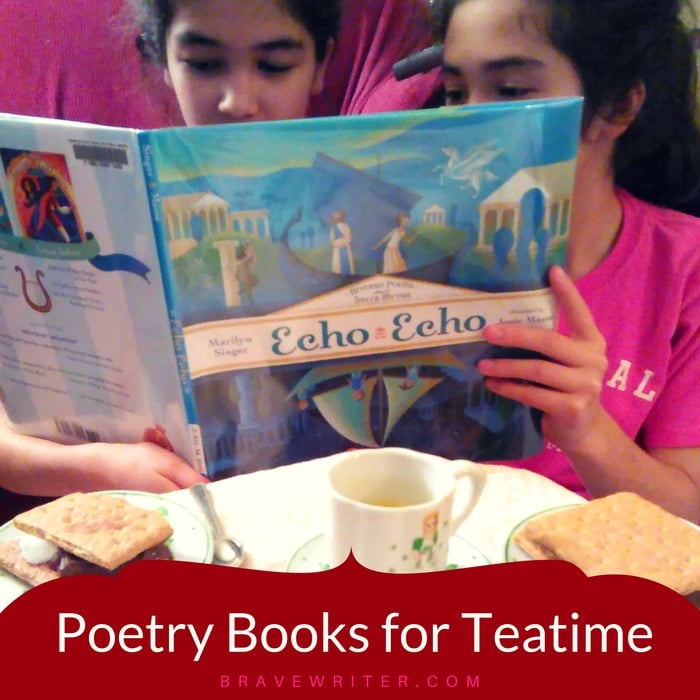
Since then all three of us have had several teatimes. I prepare a sweet snack and hot chocolate or lemonade. We set the table with lovely, fragile dishes and a cheap boquet of flowers from the grocery store. My five year old and I take turns reading poems from our growing collection of poetry books. The three year old turns her food into a growing mound of crumbs. We have a good time and move on to the rest of the day.

Then last week teatime started paying extra dividends. We were on our weekly nature walk when I heard my five year old say

“Under the lily pads,
Throughout the pond,
Nice and pretty,
Nice and blond.”

At the first two lines I thought she was quoting something from teatime. Then with the last two lines, it dawned on me that she had created her own poem about the white fish we were looking at.

At teatime the next day, my daughter asked if she could recite her own poem, and of course I said yes.

Song Lyrics, poetry and, of course, tea

Monday, April 20th, 2009

If you need some quick copy work, look no further than your iTunes or CD rack. Song lyrics are our culture’s poetry. All those poetic devices you want to teach your kids can be just as easily taught with a good song. For tomorrow’s tea, gather some of your favorites and ask your kids to pick a favorite song to share. Print the lyrics (you can Google song lyrics by putting the song title into the Google search bar and they will pop right up). Then while you sip, play the song and look at the lyrics together. Look for metaphor, simile, rhyme, rhythm, imagery, alliteration, internal rhyme (where the words rhyme in the middle of the line, not necessarily only at the end). It will be a refreshing break from books. (Hint: I do this in every comp class I teach at our homeschool co-op and it is the most favorite activity of the whole year.)

(more…)

Tuesday Poetry Teatime: We need photos!

Tuesday, April 14th, 2009

My photo stream for Tuesday Teatimes has dried up! If you send me your photos, with a little explanation of how poetry and tea went in your household, we send you a free already published issue of the Arrow or the Boomerang. Your choice! Send your photos and stories to: Julie.

I was asked recently why the study of poetry is important to a robust language arts and writing lifestyle and thought I’d share those thoughts here.
(more…)

April: National Poetry Month

Wednesday, April 1st, 2009

Did you know that? Old hat for Brave Writer fans, right?

One of the funny things about being in the “hot seat” for writing and language arts is that I’ve become a confessor of sorts. Mothers like to corner me at conferences or in the hallways of our co-op to ask me their questions and to tell me their guilty tales of failed writing attempts. One question I get frequently is: “How do I teach poetry? Do I have to? I’ve never liked it and don’t understand it. Truth is: we never read it.”

If that’s you, if you’re wondering how to give a lesson in poetry to your kids when you never spent much time with it yourself, I’ve got some ideas for you! April is obviously just the right month to tackle it.
(more…)

Email: Scavenger hunt (!) and original poetry

Thursday, September 11th, 2008

Let me alert you to two great things about this email.

1) How awesome is it to have your kids bring original poetry to the teatimes? I get emails sharing this same story again and again. You just never know what will catalyze the poet in your child! Remember: the right answer is, “Yes! Bring it. Can’t wait to hear it.”

2) A scavenger hunt for your school work? WOW! Wish I’d have thought of it.

I’m finally kicking our Poetry and Tea Time back into gear for the year.  I asked each kid to find two poems they liked to bring to read at Tea Time.  Nathan asked if he might bring two original compositions in addition to selecting two.  Um, yeah, you can do that.  Wait, twist my arm. Ok, uncle.  Go ahead.  Write original poetry.

Here is his AUTUMN acrostic:
Azure skys, brown leaves.
Under the trees, the black bear leaves.  Under the meadow,
The black bear sleeps.
Under the leaves, the jay stops his song.
Moving day has come along.
Naught but bare trees now are left, as frost steals up to make a theft.

Yesterday, as an aside in his Scavenger School (I hide their assignments all over the house, so they end up doing math in the bathtub and such), I asked him to write a poem.  Here it is, an acrostic (I guess he likes those) on SEASONS:

Snowy winter
Excellent spring
April rains
Summer sunny days
Oops, time to dig out long sleeve shirts and pants
Nothing but a beautiful fall
Snowy winter again.

Blessings,
Holly

Check out Holly’s blog!

Concrete Poetry Quilt

Thursday, June 5th, 2008

One of our local Brave Writer Moms combines writing with sewing in a million different ways. Her recent success is this poetry quilt where kids wrote poems together and then quilted them into fabric squares. For local Cincinnatians, this quilt will be hanging in the Green Hills Library all summer. Thanks to Lora Wolke and all her creative kids for sharing it with us.

Two Word Poems

Wednesday, April 23rd, 2008

If you’re sick of writing lengthy pieces and revising, now’s the time for short and sweet:

Examples:

I—
Why? (Eli Siegel)

You.
Boo! (Anon)

bugs
ugh(s) (students in a classroom)

To help you out, get a book. Grab one word and find another to match it (rhyme it, or address it). You can create a word picture, a thought, an idea, an action. Post your best ones in comments.

Here are a few to read to help you think:

narrow
arrow

sea
wheeeeeee!

fog
bog

wolf…
scarf (summing up Little Red Riding Hood in two words!)

I look forward to your two word poems!