Archive for the ‘Language Arts’ Category

Email: Spelling

Thursday, May 14th, 2009

Hello, Julie.

I have some samples and questions regarding my son’s horrid spelling that I was hoping you would not mind giving me some guidance with.  My son, Clay, just turned 9 in March and he says he hates to write (and read).  He reads at grade level (3rd) or a little below.  He enjoys stories ~ he says he hates reading however because he stresses himself out regarding the length of the story and the amount of writing per page.  He does plenty of copy work and has very neat writing.  He is struggling with creative writing because he is challenged to get his thoughts out of his head and onto paper.  We don’t do a lot of creative/freewriting becasue he is young and I don’t push him.

(more…)

Lists

Thursday, April 2nd, 2009

Writing wears kids out, have you noticed? They may get that burst of linguistic energy working for them (when the inspiration strikes, they’re hard to stop!), but when they’re done, they’re done. Sometimes after a successful writing project, all anyone wants to do is lie about doing nothing.

While taking some time off, or while your kids aren’t quite proficient enough to write lengthy passages of prose, you might try writing lists. Lists can be an incredibly therapeutic way to interact with language. For one thing, there is no shortage of topics for lists. Let me give you a quick list (ha!) of what you can list:
(more…)

April: National Poetry Month

Wednesday, April 1st, 2009

Did you know that? Old hat for Brave Writer fans, right?

One of the funny things about being in the “hot seat” for writing and language arts is that I’ve become a confessor of sorts. Mothers like to corner me at conferences or in the hallways of our co-op to ask me their questions and to tell me their guilty tales of failed writing attempts. One question I get frequently is: “How do I teach poetry? Do I have to? I’ve never liked it and don’t understand it. Truth is: we never read it.”

If that’s you, if you’re wondering how to give a lesson in poetry to your kids when you never spent much time with it yourself, I’ve got some ideas for you! April is obviously just the right month to tackle it.
(more…)

Close Reading Tips

Monday, March 30th, 2009

To be a good academic writer, it helps to be an effective reader. Close reading of texts is the key. I found a great set of tips here:

Close Reading Tips

Late Readers

Thursday, March 19th, 2009

I shared a bit about my family and their reading habits. Let’s look at what you can do with late readers in yours.

First of all, don’t fall for the idea that if your kids were in school, they’d be reading. Plenty of kids fall through the cracks in school too, and many are put in the wretched position of having to be identified as poor readers by virtue of being gathered together into a late reader’s group! Not only that, the primary function of school is to get a group of kids to assimilate skills and information at about the same pace. That means falling behind is a problem to be solved. It means that your child is a problem to be solved. At home, there is no “falling behind.” Your child is not a problem.The only goal is to move at a pace that supports and affirms your child’s progress.
(more…)

Language Arts for everyone

Thursday, October 2nd, 2008

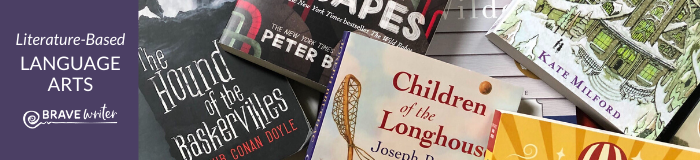
Brave Writer has launched its new year of the Arrow and the Boomerang, our tailor-made tools to help you execute your best intentions with regard to grammar, spelling, punctuation and writing mechanics. These tools feature a terrific, classic work of fiction while highlighting passages that assist you in teaching these language arts elements to your kids in the context of real writing.

Sometimes I’m asked if these tools are sufficient for teaching grammar, in particular. What I’ve noticed over the years of home educating five kids myself as well as the thousands of students we’ve now taught through Brave Writer is that the best education for the mechanics of writing is reading real writing. Some parents complain, however, that their kids read a ton and aren’t making the connection between what they read and what they write. It worries them! And of course it does! These are your kids.

What the Arrow and Boomerang do (and likewise, the high school already-published issues of the Slingshot) is to give you the ability to feature language arts elements in the context of great writing! Your kids naturally come to adopt the mechanics of writing in English through the soothing, repetitive practices of reading, pondering, copying and writing the passages in their own hand.

The power of this methodology came clear to me again just this week. My 14 year old son, Liam, who has struggled a lot with writing (has dysgraphia and was delayed in writing), has suddenly blossomed. His last year of copying passages from Redwall (his previous obsession) has borne fruit! As he started writing his own reviews of novels he’s reading, the flair to his natural writing voice, his “knack” for punctuation and his spelling are startlingly accurate. Sure he’s got some run-on sentences and occasional fragments. We can address those. But the heart of his writing is pure flair and personality, mixed with terrific spelling and a reasonable grasp of basic punctuation.

I did no formal teaching of grammar with this child. I’ve just continued to trust the process of reading aloud, read to self, talking a lot about the novels and stories and then copying the passages. We haven’t even graduated to dictation yet! Still the results are impressive.

To take a look at the Arrow or Boomerang, go to their website pages. Download the free samples and try them this month. Then if you like them, feel free to sign up for the monthly subscriptions or order back issues tailored to the books you’re reading. You’ll be glad you did.